Term and health insurance for a salaried household: how much cover at 32 with a home loan and a child, whether the employer's policy is enough, and what a spouse needs to claim
Sizing term cover at 32 with a home loan and a child, whether a group health policy is enough, porting to your own, and what a spouse needs...

Contents
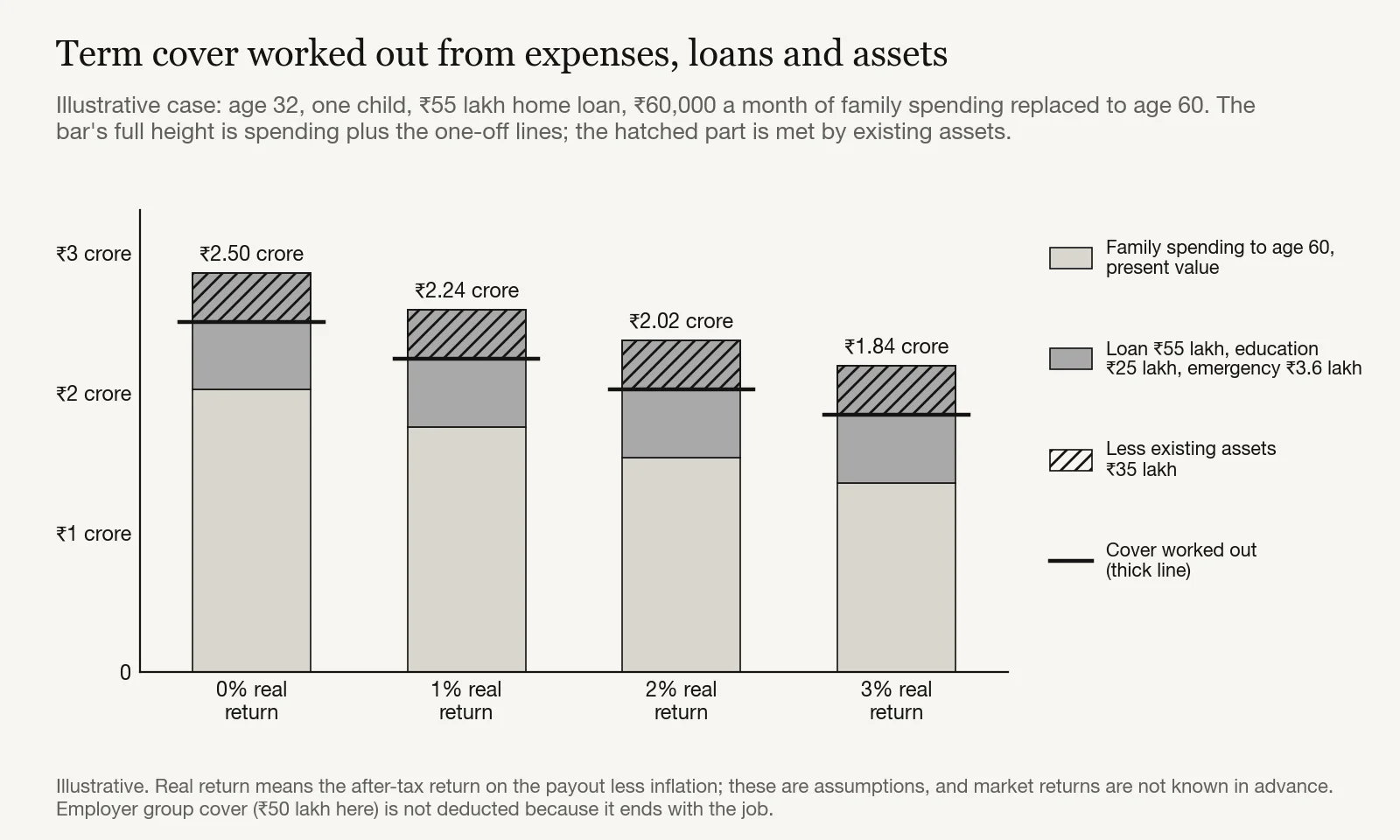
For a 32-year-old with a ₹55 lakh home loan, a one-year-old child and ₹35 lakh saved, the worked case below puts term life cover at ₹1.84 crore to ₹2.50 crore. The sum adds the family's spending to the earner's age 60, the loan and the child's education, and takes off the savings. The range comes from the return the payout is assumed to earn after inflation. The employer's group life and health cover is left out. Both end with the job.
Group health cover pays while the job lasts, up to its sum insured and its room-rent terms. The waiting periods it has served move to a policy of your own only through IRDAI's migration and portability rules, which need unbroken cover. This guide gives the arithmetic for both, the nominee and claim rules that decide how a spouse gets the money, and the tax and GST position for tax year 2026-27. It names no insurer and no policy. Corpus has applied to SEBI for registration as an investment adviser. This guide explains how the rules and the policy documents work; it does not recommend any scheme.
Three ways of sizing term cover
The three common methods give very different numbers for the same person. We know of no IRDAI rule that fixes cover as a multiple of income; each insurer sets its own limits against income.
- A multiple of income. Annual income times a number of years. On a ₹28 lakh salary, ten times is ₹2.8 crore and fifteen times is ₹4.2 crore. It ignores the loan, the savings and the size of the family.
- Expenses plus liabilities, less assets. The family's yearly spending without the earner, for as many years as it has to be met, at present value, plus debts to clear and goals such as education, less investments the family can draw on. The worked case uses this method.
- Human life value. The present value of what the earner would have brought home until retirement: income after tax, less the earner's own spending. On the same inputs (₹28 lakh less ₹4,13,400 of new-regime tax and ₹2.4 lakh of own spending, so ₹21,46,600 a year) it is ₹4.03 crore to ₹6.01 crore, because it counts every future rupee of income, including the part that would have been saved.
The assumption sits in the present-value step. Over 28 years, spending of ₹7.2 lakh a year adds up to ₹2.02 crore. If the payout earns 2% a year more than inflation after tax, ₹1.53 crore meets the same spending in today's rupees; a spreadsheet's present value function, given that rate, 28 periods and the yearly amount, returns the figure. But market returns are not known in advance. So the table shows four rates.
Age 32, a home loan and a child: every line
The illustrative household: the earner is 32 with a gross salary of ₹28 lakh, the spouse is at home and the child is one. The loan has ₹55 lakh outstanding. Apart from the EMI and the earner's own costs of ₹20,000 a month, the family spends ₹60,000 a month. The employer gives ₹50 lakh of group term life cover and a ₹5 lakh group health floater.
Only the first line moves with the assumption. The rest net to ₹48,60,000 at every rate.
With the employer's ₹50 lakh counted, the 2% figure is ₹1,51,82,516. But that cover stops with the job, and a policy bought later is priced at the later age and health. If the loan carries its own cover, the loan line drops out and the figure is ₹1,46,82,516. The case stops at 60. It assumes retirement is funded separately.
What changes when the first child arrives
Without the child, with family spending of ₹50,000 a month, no education line and a ₹3 lakh emergency fund, the 2% figure is ₹1,50,68,763. The child adds ₹51,13,753. That is ₹25 lakh of education, ₹25,53,753 for ₹10,000 a month more of spending over 28 years, and ₹60,000 more in the emergency fund.
The other lines a first child touches:
- Term cover. Cover is fixed at issue unless the contract has an option to raise it. Otherwise extra cover is a second policy, underwritten at the age and health of that date.
- Health cover. A newborn joins a family floater on the policy's terms, and maternity cover, where there is any, has a waiting period. IRDAI's health FAQ puts the longest waiting period a health policy can carry at 36 months. Group policies state their own maternity and newborn terms in the customer information sheet given to members.
- Nominees. For a minor nominee, section 39 of the Insurance Act lets the policyholder appoint someone to receive the money, and SEBI's nomination form asks for the minor's date of birth.
- Tax, old regime only. The child's health premium sits inside the ₹25,000 for self and family under section 126; tuition fees later count within the ₹1.5 lakh of section 123.
This guide does not answer how to save for the education itself. That is a portfolio question.
The home loan's own cover
Cover on a home loan comes in four forms: two that the lender arranges, and a term plan of your own, assigned to the lender or not. Each pays someone different.
IRDAI's life products master circular (12 June 2024) limits a credit life policy's term to the outstanding loan tenure and ties its cover to the original loan or the loan schedule at inception. So a floating-rate loan whose tenure stretches after a rate rise can owe more than the schedule. When a policy assigned to a lender pays out, the lender gets only the outstanding dues, which the nominee confirms, and the nominee gets the balance (policyholder protection master circular, 5 September 2024). Section 39(4) of the Insurance Act keeps the nomination alive under such an assignment.
From 1 January 2027, RBI's amended conduct directions for banks and NBFCs (15 June 2026) bar making a loan conditional on buying a third-party product the lender sells. Where a lender requires insurance as a safeguard, the borrower can buy it from any provider, and no product can be paid for out of the loan without explicit consent. Housing finance companies are covered too. A third amendment issued that day applies the NBFC rules to them.
Take an illustrative ₹55 lakh loan at 7.75% over 20 years, with an EMI of ₹45,152. The balance falls to ₹47,96,912 after five years, ₹37,62,348 after ten and ₹22,40,029 after fifteen. So a level ₹55 lakh cover is ₹32,59,971 above the balance by year 15, while a cover tied to the loan pays only the balance.

Paying the loan down faster also shrinks the loan line in the cover sum; whether to prepay the home loan or keep investing is a separate after-tax calculation.
Whether the employer's group health policy is enough
Two questions decide it. One is whether its sum insured and room-rent terms meet a large hospital bill; the other is what the family has when the job ends. The second is fixed. IRDAI's policyholder protection master circular makes the employer the master policyholder and the employee a member, so the cover lasts as long as the membership, to the date the group policy sets for someone who leaves.
The first is answered from the customer information sheet, which IRDAI's health master circular of 29 May 2024 requires for group members too, listing exclusions, sub-limits, deductibles and waiting periods.
- The floater. One sum insured is shared by everyone covered. For a family of four on a ₹5 lakh floater, ₹5 lakh is the year's total, whoever is admitted.
- Room rent and proportionate deduction. Take a room limit of 1% of a ₹5 lakh sum insured, ₹5,000 a day. Five days in a ₹9,000 room produce a bill of ₹3,00,000: room ₹45,000, charges linked to the room category ₹1,80,000, medicines ₹75,000. Under an illustrative clause that scales room and linked charges by 5,000 over 9,000 and leaves medicines alone, the policy pays ₹2,00,000 and the family ₹1,00,000. Which charges a clause scales is in the policy wording.
- Sub-limits and co-payment. A sub-limit caps what is paid for a named treatment or item. With a co-payment, the policyholder pays a share of every admissible claim.
Moving from a group policy to your own
There are two routes. Both carry credits only up to the old sum insured.
- Migration is a move to another policy with the same insurer. The health master circular names members of group policies among those who can carry the credits earned for no-claim bonus, specific waiting periods, the pre-existing disease waiting period and the moratorium. Under the 2024 product regulations the insurer may underwrite the move if the person has had less than 36 months of continuous cover.
- Portability is a move to another insurer, allowed for individual, family floater and group policies at renewal, with the application made 60 to 30 days before the renewal date. The old insurer sends the claim history through the Insurance Information Bureau within 72 hours, and the new one decides within five days. Neither may charge for the move.
And any sum insured above the old cover can be underwritten afresh and starts its own waiting periods and moratorium. The rules set no window for a leaving employee; the group policy and the insurer do. After a break in policy, in IRDAI's words, accrued benefits may be lost completely.
Schedule III of the IRDAI (Insurance Products) Regulations, 2024 sets the limits, and IRDAI's health department FAQ repeats them:
Claim timelines are the same for group and individual policies: a cashless decision within one hour, final approval at discharge within three hours (any charge for a longer wait falls on the insurer's shareholders' funds), and reimbursement within 15 days. The insurer collects documents from the hospital, and renewal cannot be refused because of past claims.
A base policy with a super top-up, in rupees
Top-up policies apply their deductible to each claim. Super top-ups apply it to the year's claims added together. The difference shows in a year with two admissions. Take a ₹10 lakh family floater, ₹50 lakh of cover above a ₹10 lakh deductible, and two admissions in one policy year costing ₹7 lakh and ₹9 lakh.
The third row is someone whose base was the employer's ₹10 lakh group cover and whose job has ended: the deductible stays, so the first ₹10 lakh of the year's bills is the family's. This money comes from savings, one of the things an emergency fund is sized for.
With two indemnity policies the policyholder chooses which insurer to claim from first. Under paragraph 18 of the health master circular, that insurer gets the details of the other policy and coordinates settlement of the balance.
Checking your own policies for gaps
We do not name apps. Whoever does it, a review reads the same papers: the policy schedule, the customer information sheet, the copy of the proposal form that IRDAI requires insurers to send with the policy, the nomination acknowledgement the insurer must give under section 39(3), and the employer's benefit summary.
The family can do this with the papers and a spreadsheet. SEBI-registered investment advisers charge a fee and take no commission; who may legally advise you sets out the registrations. An insurance agent or broker registered with IRDAI can advise on insurance alone without SEBI registration, under regulation 4(b) of SEBI's investment adviser regulations, and is paid by insurers on the policies sold.
If the earner dies: who receives the money
- Life policies. Section 39 of the Insurance Act lets the policyholder name and change nominees until the policy matures. Under section 39(7), where a policy on the policyholder's own life names a parent, the spouse or a child, that nominee is beneficially entitled to the money. Other nominees receive it with no such title under the section. Creditors' rights to the proceeds survive (section 39(9)).
- A Married Women's Property Act policy. Section 6 of the 1874 Act makes a policy taken by a married man on his own life, and expressed on its face to be for his wife or children, a trust for them: outside his control and his creditors' reach (unless taken out to defraud them), and no part of his estate. It is paid to trustees named for the purpose or else the state's Official Trustee, and section 39 does not apply. We know of no equivalent for a woman insuring her own life for her husband; section 39(7) covers that case.
- The three-year line. Under section 45 a life policy cannot be questioned on any ground three years after the latest of the dates it was issued, its risk began, it was revived or a rider was added. Within three years an insurer can repudiate for fraud or a material misstatement, and where there was no fraud it refunds the premiums within 90 days.
- Mutual funds and demat accounts. SEBI rewrote nomination from 1 March 2025, then replaced that circular and every earlier one with its circular of 29 May 2026, in force from 1 September 2026: up to three nominees, compulsory for new single-holder accounts unless the holder opts out, optional for joint holdings, and every joint holder's consent to any change. Shares are optional and equal by default. Under SEBI's transmission circular of 23 July 2026 the nominee receives the holdings as trustee for the legal heirs.
So a spouse named on a life policy keeps the money, while a spouse named on a folio holds the units for whoever the heirs are under the will or, without one, under succession law.
The papers a spouse would need
Nominations shorten the list.
If no one kept a list, IRDAI's Bima Bharosa site links to each insurer's page of unclaimed amounts, where a search matches any two of policy number, PAN, name and date of birth. Money unclaimed for ten years moves to the Senior Citizens' Welfare Fund and stays claimable for 25 years more. The consolidated account statement lists every folio and demat holding under one PAN. Tax and exit loads on inherited folios are covered separately.
Tax on premiums and payouts in each regime
Premium deductions are an old-regime item. The payout rules are the same in both. Sections are from the Income-tax Act, 2025, in force from 1 April 2026.
At the 30% slab with cess, a ₹25,000 deduction reduces old-regime tax by ₹7,800 and a ₹50,000 deduction by ₹15,600. But those count only when total old-regime deductions pass the break-even in the old and new regime comparison: ₹8 lakh beyond the standard deduction at salaries from ₹25 lakh to ₹50 lakh.
GST on premiums since 22 September 2025
Individual life and individual health premiums paid on or after 22 September 2025 carry no GST. Notification No. 16/2025-Central Tax (Rate) of 17 September 2025 added entries 36C and 36D to the services exemption list: life and health insurance supplied to an insured who is not a group. The Department of Financial Services page, last updated on 5 January 2026, confirms that family floaters are covered and that the date of payment decides the rate. Group policies stay at 18%. This covers an employer's group health and group life cover and a lender's group credit life policy. Notification No. 07/2026-Central Tax (Rate), which amended the same exemption list from 1 November 2026, left entries 36C and 36D as they were. We found no other change.
Frequently asked questions
How much term insurance do I need at 32 with a home loan and a child?
The expenses-plus-liabilities method adds the family's yearly spending without the earner, at present value to retirement age, to the home loan, the child's education and an emergency fund, and takes off existing investments. With ₹60,000 a month of family spending, a ₹55 lakh loan, ₹25 lakh for education and ₹35 lakh saved, that is ₹1.84 crore to ₹2.50 crore, depending on the real return assumed. Employer group cover is not counted, as it ends with the job.
Is my company health insurance enough, or do I need my own policy?
Company cover lasts while you are a member of the employer's group and stops on the date its terms set when you leave. While it runs, what matters is whether its sum insured, shared by the whole family on a floater, and its room-rent clause meet a large bill. IRDAI's rules let group members carry waiting-period credits to an individual policy by migration or portability, up to the old sum insured, if cover is unbroken.
Which app reviews my insurance policies and shows where I am under-covered?
We do not name apps. Any review checks the cover against a worked-out need, each policy's end date, riders, the exclusions and waiting periods in the customer information sheet, disclosures on the proposal form, and the nominee. It can be done with the papers and a spreadsheet, or with a SEBI-registered investment adviser (paid a fee, no commission) or an IRDAI-registered agent or broker (paid by insurers).
Expecting our first child: what changes in our investments and insurance?
In the worked case, at a 2% real return, the child adds about ₹51 lakh to the term cover figure, from education, higher spending over 28 years and a bigger emergency fund. On health cover, the questions are when a newborn joins the floater and the maternity waiting period, which sits under IRDAI's 36-month ceiling on waiting periods. For a minor nominee on a life policy, section 39 lets the policyholder appoint someone to receive the money while the child is a minor. How to save for the education itself is a portfolio decision this guide does not make.
If something happens to me, how will my spouse access my mutual funds and insurance?
The life insurer pays a nominee on a claim form, the death certificate and its listed papers, and a spouse nominee keeps the money under section 39(7) of the Insurance Act. For funds and demat holdings, a nominee spouse gives a transmission form, a verifiable death certificate, the account statement and their own demat client master list, and holds the units for the legal heirs. Without a nominee, the papers depend on the value held, with thresholds at ₹10,000 and ₹10 lakh per fund house.
Can I port my company health insurance to a personal policy when I leave my job?
IRDAI's rules allow migration to an individual policy with the same insurer, carrying waiting-period, no-claim bonus and moratorium credits, and portability of group policies to another insurer at renewal. The new insurer underwrites the proposal. IRDAI's rules set no date for a leaving employee; the group policy and the insurer do.
Is there GST on term insurance and health insurance premiums now?
Not on individual and family policies. Premiums paid on or after 22 September 2025 for individual life and health insurance, family floaters included, are exempt under Notification No. 16/2025-Central Tax (Rate). Group policies, such as an employer's group health cover or a lender's group credit life policy, still carry 18%.
Is term insurance premium deductible in the new tax regime?
No. The new regime allows neither life premiums (section 123, the old 80C) nor health premiums (section 126, the old 80D). In the old regime a term premium counts within the ₹1.5 lakh limit, and health premiums up to ₹25,000 for the family and ₹25,000 or ₹50,000 for parents. Death payouts from life policies are excluded from income in both regimes.
Related guides
- Idle cash and the emergency fund: where to keep it, after tax
- Prepay a loan or keep investing: home, education and car loans after tax
- Old or new tax regime for a salaried person in 2026-27
- Tracking every investment in one place: what each statement covers
- Consolidating 17 mutual funds into 5: exit loads, capital gains and the order of operations
- Who is legally allowed to tell you what to do with your portfolio
Sources: Insurance Act, 1938, sections 39 and 45 as substituted by the Insurance Laws (Amendment) Act, 2015, and the Sabka Bima Sabki Raksha (Amendment of Insurance Laws) Act, 2025 (No. 40 of 2025, in force from 5 February 2026 except its section 25), which amends neither section; Married Women's Property Act, 1874, section 6; IRDAI (Insurance Products) Regulations, 2024, Schedule III, paragraphs 1 and 7 to 10; IRDAI Master Circular on IRDAI (Insurance Products) Regulations 2024 - Health Insurance, IRDAI/HLT/CIR/PRO/84/5/2024, 29 May 2024, Chapter I paras 4, 5, 7, 8, 10 to 13 and 15 to 18; IRDAI Master Circular on Life Insurance Products, IRDAI/ACTL/MSTCIR/MISC/89/6/2024, 12 June 2024, paras 5, 6, 8, 7.16 and 7.17; IRDAI Master Circular on Protection of Policyholders' Interests, 2024, IRDAI/PP&GR/CIR/MISC/117/9/2024, 5 September 2024 (nomination, policy documents, claim timelines and documents, assignment, group policies, unclaimed amounts, portability); IRDAI Health Department FAQs, read 16 November 2026; Reserve Bank of India (Commercial Banks - Responsible Business Conduct) Second Amendment Directions, 2026 (RBI/2026-27/115) and the matching NBFC directions (RBI/2026-27/123) and housing finance company directions (RBI/2026-27/124), 15 June 2026, paras 85V-85W and 101V-101W, in force 1 January 2027; SEBI circular SEBI/HO/OIAE/OIAE_IAD-3/P/CIR/2026/12676 of 29 May 2026 on nomination for demat accounts and mutual fund folios, in force 1 September 2026, and the January 2025 circular it supersedes; SEBI circular HO/38/13/11(14)2026-MIRSD-POD/I/17111/2026 of 23 July 2026 on transmission of securities; SEBI (Investment Advisers) Regulations, 2013, regulation 4(b); Income-tax Act, 2025 (No. 30 of 2025) as amended by the Finance Act, 2026: sections 11(1) and Schedule II Sl. No. 2, 17(2)(c), 92(2)(l), 123 and Schedule XV paras 1 and 2, 126 and 202; Notification No. 16/2025-Central Tax (Rate), 17 September 2025 (G.S.R. 666(E)), entries 36C and 36D, and Notification No. 07/2026-Central Tax (Rate), 27 October 2026; Department of Financial Services, exemption of GST on individual life and health insurance policies, updated 5 January 2026. Worked cases are illustrative and use assumed real returns. Corpus has applied to SEBI for registration as an investment adviser. This page explains how the rules and policy documents work and does not recommend any scheme. Investment in securities market are subject to market risks. Read all the related documents carefully before investing.
This is the lead-generation form
Get info from your blog visitors for lead funnel
Corpus
Guides on reviewing a mutual fund portfolio in India: reading your CAS, overlap, commission, what advice costs and who may legally give it. Written by the Corpus team.
Visit Site