Prepay the loan or keep investing: the after-tax cost of home, education, car and personal loans and card dues, and the return an investment has to match
The after-tax cost of a home, education, car or personal loan and card dues, and the return an investment needs to match each...

Contents
Every rupee sent to a loan earns exactly the loan's interest rate, after whatever tax deduction that interest was getting. Every rupee left in a mutual fund earns an unknown return, less the tax on its gains. Prepaying or investing is a comparison of those two numbers, and only the first can be known in advance.
This guide works out the known side for each loan a salaried person usually carries, then computes the return an investment would need, before its own tax, to match it. The rules are those in force in November 2026, for tax year 2026-27 under the Income-tax Act, 2025. The examples use a person in the 30% slab and are illustrative. How much certainty is worth to you, and how much cash you want within reach, are your choices. Corpus has applied to SEBI for registration as an investment adviser. This guide explains how the rules and the statements work; it does not recommend any scheme.
What each loan costs after tax, in November 2026
Only two of these loans get any tax relief, and both reliefs belong to the old regime. Under the new regime, the default (section 202), every loan here costs its stated rate, with one exception for a house that is let out.
For a person paying 30% tax plus the 4% cess (31.2% in all), a full deduction turns 8.5% into 5.85% and 10.5% into 7.22%. Which regime leaves you with less tax depends on all your deductions together, and the comparison of the two regimes for a salaried person works that out.
Rates have just moved. The RBI raised the repo rate to 5.50% on 7 October 2026, and its next meeting is on 2 to 4 December. New floating-rate home loans from banks have been tied to an external benchmark since 1 October 2019, usually the repo rate, and are reset at least once in three months. One large public sector bank shows home loans from 7.50% with effect from 15 October 2026, and that is a starting rate.
The return an investment needs to match each loan rate
Divide the loan's after-tax rate by one minus the tax rate on the investment's gains. The result is the pre-tax return the investment has to earn for a year to leave you where prepayment would have.
For a person in the 30% slab with income under ₹50 lakh, the tax on the investment side, cess included, is 13% on an equity fund's long-term gains above ₹1.25 lakh a year (section 198), 20.8% on its short-term gains (section 196), and 31.2% on fixed deposit interest and on gains from debt fund units bought since April 2023.
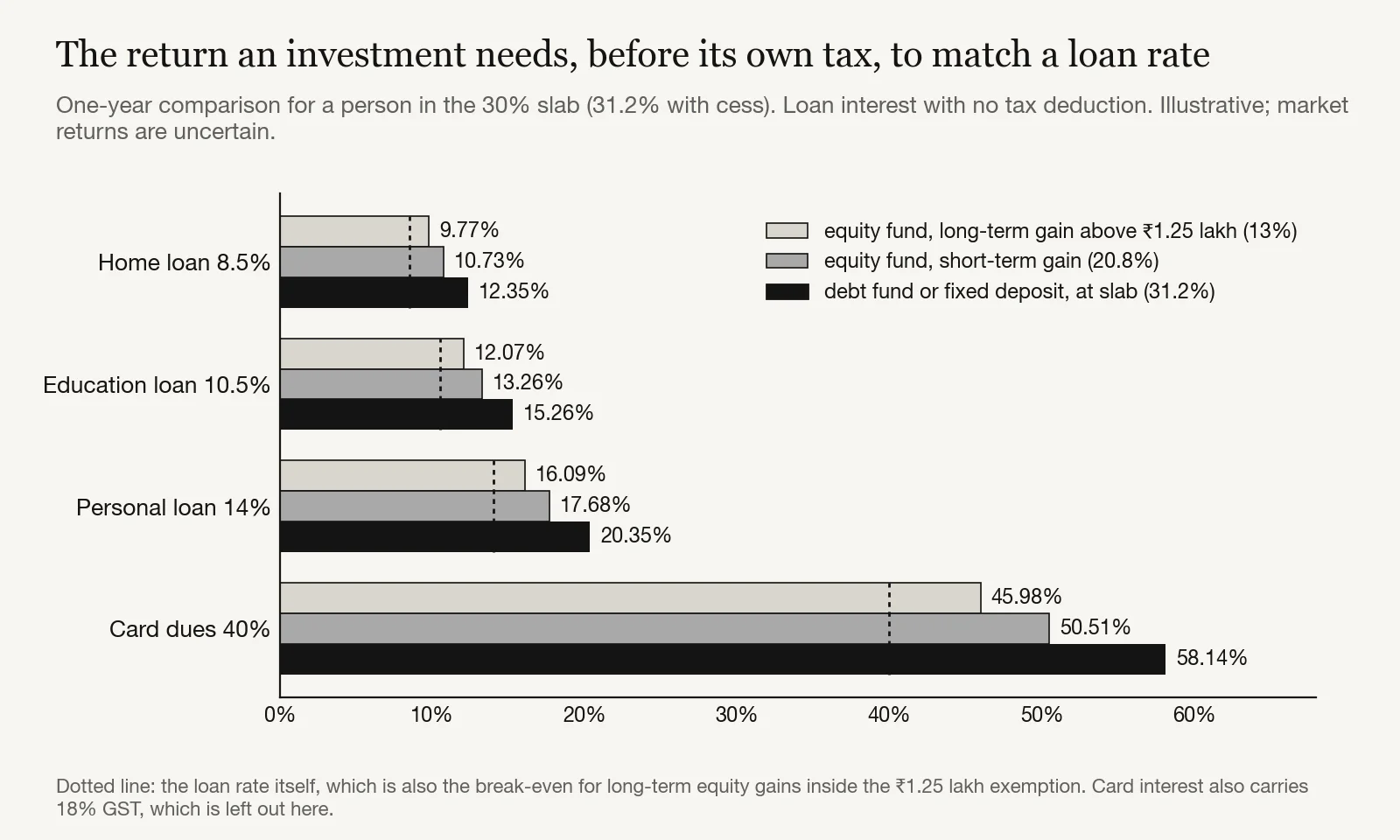
Where the interest is fully deductible in the old regime, the bar is lower. An 8.5% loan then costs 5.85%, and the matching returns are 6.72% for an equity fund's long-term gain above the exemption and 8.50% for a debt fund or deposit. At 10.5% the cost is 7.22% and the matching returns are 8.30% and 10.50%.
These are one-year figures, and the 40% row is a round number: issuers publish up to 45% a year before GST. Tax on a fund's gain is paid only on redemption, so over a long holding the equity figure comes down a little: against an 8.5% loan over ten years, a single redemption taxed at 13% needs 9.37% a year.
The loan side is certain. The fund side is not. An equity fund can return more than these figures over a period, or less, or lose money, and a number in this table is a threshold for comparison that says nothing about what any fund will earn.
Money prepaid into a loan also cannot be drawn back out when the car breaks down. Where the emergency fund and idle cash can sit is a separate question with its own guide, and everything here is about the surplus beyond it.
What it costs to take money out of mutual funds
Repaying a loan from existing investments has a one-time cost that fresh savings do not: tax, and sometimes an exit load, on the units redeemed.
Redemptions come out of each folio oldest units first. For equity-oriented funds, gains on units held over twelve months are long-term: the first ₹1.25 lakh of such gains in a tax year is untaxed and the rest is taxed at 12.5%. Units held twelve months or less are taxed at 20%. Debt fund units bought on or after 1 April 2023 are taxed at slab however long you held them (section 76). All rates are before cess.
The tax is on the gain, and the gain is often a small part of the amount redeemed. ₹5 lakh of long-term equity units carrying ₹1.5 lakh of gain costs ₹3,250 in tax if nothing else was booked that year (13% of the ₹25,000 above the exemption). The same ₹5 lakh from units bought eight months ago with ₹40,000 of gain costs ₹8,320, plus the exit load if the scheme has one. Loads differ by scheme. Many equity schemes cut theirs in 2025-26, so check the current fact sheet.
Your detailed CAS lists every lot with its date and NAV, and reading it line by line shows which lots a redemption would take. It is November, so a large redemption can be split across 31 March to use two years' exemptions; the guide on the ₹1.25 lakh exemption covers that arithmetic, and the consolidation guide has the rate table for every fund type.
Home loan at 8.5% with SIPs running
With no deduction, the SIP has to earn 8.5% to 9.77% a year, depending on how its gains are taxed, to match a prepayment. The deduction lowers that, but it is narrower than it looks.
For a house you live in, section 22 (the old section 24(b)) allows up to ₹2 lakh of interest a year, in the old regime only; section 202(2) withdraws the section 22(1)(b) deduction for such a house in the new regime. The Finance Act, 2026 put the instalments of pre-construction interest inside the same ₹2 lakh. But a ₹50 lakh loan at 8.5% carries ₹4,21,182 of interest in its first year, more than twice the limit.
So in the early years a prepayment removes interest that was not being deducted anyway. And the last rupee of the loan costs the full 8.5% in either regime until the yearly interest drops under ₹2 lakh, which at 8.5% means a balance of about ₹23.5 lakh. On this loan's original schedule that is year 15.
But a let-out house is different. The full interest is deductible against the rent in both regimes. In the old regime a loss under house property can be set off against salary up to ₹2 lakh a year (section 109), and the rest carries forward for eight years against house property income (section 110). In the new regime the loss cannot be set off against any other head.
What a prepayment does to an illustrative ₹50 lakh loan at 8.5% for 20 years (EMI ₹43,391, total interest ₹54,13,879 if the rate never changed):

This is the same 8.5% seen another way. ₹5 lakh repaid after year 1 compounds at 8.5% into roughly ₹21 lakh of EMIs that never have to be paid in years 17 to 20, and the ₹16 lakh is that sum less the ₹5 lakh itself.
There are two ways a lender can apply a prepayment. If the EMI stays, the loan shortens, as above. If the 20-year tenure stays, the EMI falls: after the year 1 prepayment it drops from ₹43,391 to ₹38,964, and ₹5,09,408 of interest no longer falls due. An RBI circular of August 2023 lets borrowers of floating-rate EMI loans choose a higher EMI, a longer tenure or a mix at each reset, and prepay in part or in full at any point.
There is no charge for prepaying. Banks have been barred from charging foreclosure fees on floating-rate home loans since June 2012. RBI's Pre-payment Charges on Loans Directions of July 2025, for loans sanctioned or renewed from 1 January 2026, widen this: no bank, co-operative bank or NBFC may charge an individual for prepaying a floating-rate loan taken for a non-business purpose, in part or in full, whatever the source of the money and with no lock-in. Fixed-rate loans are outside the bar. On those a lender may charge under its own policy, on the amount prepaid, and only if the charge is written in the sanction letter, the loan agreement and the Key Facts Statement.
In the old regime a prepayment is also principal repaid, and counts towards the ₹1.5 lakh under section 123 (the old 80C) if EPF and other items have not filled it.
Redeeming mutual funds to close a personal loan early
There is no deduction for a personal loan in either regime, so at 14% the break-even is the 14% row: 16.09% for an equity fund's long-term gain above the exemption, 20.35% for a debt fund or deposit.
Two one-time costs come first. One is the tax and load on the redemption. The other is the lender's foreclosure charge, because personal loans are mostly fixed-rate and outside RBI's bar. One large private bank's schedule in November 2026 charges 4% of the outstanding principal up to 24 EMIs, 3% from 24 to 36 and 2% after that. The schedule adds GST to these charges, which lenders bill at 18%.
Take ₹5 lakh outstanding with 24 EMIs of ₹24,006 left at 14%. The interest still to fall due is ₹76,155. The 4% charge with 18% GST is ₹23,600. So closing the loan today removes ₹52,555 of net cost, before tax on whatever is redeemed to do it. The nearer a loan is to its end, the more of the remaining interest the charge takes.
The loan agreement and the Key Facts Statement carry the actual figures.
₹2 lakh of card dues and ₹15 lakh in mutual funds
Card dues carried past the due date are the last row of the break-even table, and issuers publish rates above its 40%. The arithmetic here is mostly about how the interest is charged.
The card issuers' terms we read in November 2026 show finance charges of up to 3.75% a month, 45% a year, with GST at 18% added to the interest. On ₹2 lakh that is ₹7,500 of interest and ₹1,350 of GST: ₹8,850 a month for as long as the balance stays where it is.
How the charge builds:
- The grace period between a purchase and the due date exists only if the previous bill was paid in full. RBI's credit card directions require issuers to say in their terms that the period is suspended if any part of the previous month's bill is outstanding.
- Once it is suspended, interest runs from the date of each transaction, on the unpaid balance and on new purchases alike, until the whole amount is cleared.
- The minimum amount due covers that month's interest, fees and taxes and a sliver of principal (1% or 2% of the balance in the terms we read). RBI requires every statement to warn that paying only the minimum stretches repayment over months or years.
On the redemption side, if the oldest units in the folio are long-term and the gain fits inside what is left of this year's ₹1.25 lakh, the tax is nil. If they are short-term with, say, ₹40,000 of gain, the tax is ₹8,320, plus ₹2,000 where a 1% load applies. Either figure is close to one month's interest and GST on the card.
The education loan: paying it early, or borrowing against redeeming for an MS abroad
For a loan already running, the cost depends on the regime and on how many of the eight years are left. Section 129 (the old 80E) allows all the interest paid in a year as a deduction, with no rupee limit, for the tax year in which you start paying interest and the seven after it. The new regime does not allow it.
The conditions are narrow. The loan has to come from a bank, a financial institution notified by the government or an approved charitable institution, so a loan from a relative does not count. It has to be for the higher education of yourself, your spouse, your children or a student whose legal guardian you are. The person claiming has to be the one paying.
In the old regime at 30%, a 10.5% education loan costs 7.22% during the eight years, and the break-even for an equity fund's long-term gain above the exemption is 8.30%. In the new regime, or after year eight, the figures are 10.5% and 12.07%. A floating-rate education loan falls under the same RBI bar on prepayment charges as a home loan.
No EMIs are due during the course. One large public sector bank's scheme for study abroad charges simple interest through the course and a six-month moratorium after it, then adds the accrued interest to the principal and fixes the EMI. The first year in which any interest is paid starts the eight-year count.
For a course that has not begun, the choice is between a loan and a redemption, and tax collected at source is part of it. Since 1 April 2026, money sent abroad for education under the Liberalised Remittance Scheme attracts TCS of 2% on the amount above ₹10 lakh in a financial year (section 394; it was 5% until March 2026). None is collected where the money remitted is an education loan from a bank or notified financial institution. On ₹40 lakh sent from redeemed mutual funds, the bank collects ₹60,000. TCS is a credit against your tax for the year and comes back through the return if it exceeds the tax due.
The redemption side is the lot arithmetic above, at a larger scale. ₹40 lakh of equity units carrying ₹14 lakh of long-term gain, redeemed in one tax year with nothing else booked, costs ₹1,65,750 in tax (13% of ₹12.75 lakh). With a loan the units stay invested, market risk still attached, while interest accrues.
A ₹15 lakh car: loan or mutual funds
There is no deduction for a salaried person's interest on a personal car loan, in either regime. So the comparison is the loan rate against the break-even return, plus the one-time tax on redemption.
The electric vehicle deduction people remember, section 132 (the old 80EEB), covers loans sanctioned between 1 April 2019 and 31 March 2023. It still runs for those loans, up to ₹1.5 lakh of interest a year in the old regime. Loans sanctioned today do not qualify.
An illustrative ₹15 lakh at 9% for five years has an EMI of ₹31,138 and total interest of ₹3,68,252. To match 9%, an equity fund has to earn 9% (long-term gains inside the exemption) to 10.34% (above it), and a debt fund or deposit 13.08%. One large private bank's published car loan rates start at 8.40% in November 2026.
But a redemption has its own bill. If ₹15 lakh of long-term equity units carries ₹6 lakh of gain and nothing else was booked this year, the tax is ₹61,750 (13% of ₹4.75 lakh). Split evenly across 31 March, the same gain uses two years' exemptions and the tax is ₹45,500.
Where a car loan is fixed-rate, a change of mind later has a price. That bank's schedule charges 5% of the outstanding principal for closing a car loan taken on or after 1 December 2025.
A loan against mutual funds or a personal loan for ₹10 lakh
The units are the security for a loan against mutual funds. They stay in your name and stay invested, a lien is marked on them, and no capital gain arises because nothing has been redeemed.
Lenders' pages describe the lien as marked with the registrar, CAMS or KFintech, on the lender's request once you confirm it. Units under lien cannot be redeemed or switched until the lender releases them. Most such loans are overdraft limits, with interest charged on the amount drawn for the days it is drawn. Lender pages and guides read in 2026 put rates at roughly 9% to 12% a year.
How much you can borrow depends on who lends. For banks, RBI's revised directions on loans against eligible securities took effect on 1 July 2026:
These are ceilings, and a bank can lend less. The value used is the lower of the previous day's NAV and the six-month average NAV. For NBFCs with assets of ₹100 crore or more, RBI's directions set 50% for loans against listed shares; we know of no RBI ceiling specific to fund units for NBFCs, and each sets its own.
For ₹10 lakh at a 75% ceiling, the lien has to cover ₹13.33 lakh of equity fund units. At 50% it is ₹20 lakh. The risk a personal loan does not have is a fall in the collateral. If ₹13.33 lakh of units fall 20% to ₹10.67 lakh, the loan is 93.75% of their value. RBI gives a bank at most seven working days to cure a breach, so the borrower repays ₹2 lakh or puts ₹2.67 lakh more units under lien. If neither happens, the loan agreement lets the lender redeem units, at a time when prices are down. We found no circular or ruling that settles how such a redemption is taxed.
On a steady ₹10 lakh balance, 10.5% is ₹1,05,000 a year and 14% is ₹1,40,000. The loan against funds adds a margin call to the market risk the units already carry. The personal loan needs no collateral and has a fixed EMI; one large private bank publishes rates of 10.25% to 24%.
What the arithmetic leaves out
Prepayment runs one way. Unless the home loan is an overdraft-linked one, the money is gone until the loan ends, while fund units can be redeemed within three working days at whatever the NAV is then.
And a floating rate moves. The repo rate has changed twice in the past year, and every row of the break-even table moves with the loan rate.
The fund side of the comparison is a guess about the future. Anyone who charges for telling you which way to lean has to be registered to do so, and who that is is set out in an earlier guide.
Frequently asked questions
Home loan at 8.5% and SIPs running: should I prepay the loan or keep investing?
Prepayment earns a certain 8.5% where the interest gets no deduction: in the new regime, and in the old regime for interest above ₹2 lakh a year on a self-occupied house. To match it, an equity fund has to earn 8.5% to 9.77% a year before its own tax and a debt fund or deposit 12.35%, for someone in the 30% slab. Equity returns are uncertain and can be negative.
Should I redeem my mutual funds to close a personal loan early?
At 14% with no deduction, an equity fund would need 14% to 16.09% a year before tax to match the loan. Against that, count the lender's foreclosure charge (2% to 4% of outstanding principal plus GST on one large bank's schedule) and the tax and exit load on the units redeemed. On ₹5 lakh outstanding with 24 EMIs left, the remaining interest is ₹76,155 and a 4% charge with 18% GST is ₹23,600.
I have ₹2 lakh in credit card dues and ₹15 lakh in mutual funds: what do I do first?
Card dues carried forward cost up to 3.75% a month plus 18% GST on the interest, about ₹8,850 a month on ₹2 lakh, and new purchases cost interest from the day they are made until the full balance is cleared. Redeeming ₹2 lakh of equity fund units costs no tax if the gain is long-term and inside the year's ₹1.25 lakh exemption, and ₹8,320 if the units are short-term with ₹40,000 of gain.
Should I pay off my education loan early or invest?
In the old regime, interest on an education loan from a bank is fully deductible for eight tax years under section 129, so a 10.5% loan costs a 30% taxpayer 7.22% and an equity fund needs 7.22% to 8.30% to match it. In the new regime, or after the eighth year, the loan costs 10.5% and the matching return is 10.5% to 12.07%. A floating-rate education loan carries no prepayment charge.
Education loan for an MS abroad or redeem my mutual funds: how do I decide?
The loan side is its rate, less the section 129 deduction in the old regime. The redemption side is the tax on the units sold: 12.5% plus cess on long-term equity gains above ₹1.25 lakh a year. TCS is 2% on self-funded education remittances above ₹10 lakh a year and nil on money remitted out of a bank's education loan, and it is a credit against your tax.
Buying a ₹15 lakh car: take a car loan or pay from my mutual funds?
There is no deduction on a personal car loan for a salaried person, so at 9% the matching return is 9% to 10.34% for an equity fund and 13.08% for a debt fund or deposit. A redemption triggers tax on the gain: ₹61,750 if ₹15 lakh of long-term equity units carry ₹6 lakh of gain and go in one tax year. The loan costs ₹3,68,252 in interest over five years at 9%.
Loan against mutual funds or a personal loan for a ₹10 lakh need?
Interest on a loan against funds is charged only on the amount drawn, at roughly 9% to 12% a year on lender pages in 2026, and no capital gain is booked because the units are not sold. A bank can lend up to 75% of the value of equity fund units and 85% of debt fund units. If the NAV falls, the borrower has to repay part or add units within days, or the lender can redeem them. A personal loan has no collateral, a fixed EMI and published rates of 10.25% to 24% at one large bank.
Related guides
- Idle cash and the emergency fund: where to keep it, after tax
- Old or new tax regime for a salaried person in 2026-27
- Harvesting long-term gains before 31 March, lot by lot
- Consolidating 17 mutual funds into 5: exit loads, capital gains and the order of operations
- Credit cards and the CIBIL score: first card, the minimum due and card debt
- Tracking every investment in one place: what each statement covers
Sources: Income-tax Act, 2025 (No. 30 of 2025) as amended by the Finance Act, 2026 (ICAI consolidated text, April 2026): sections 21(6) and 22 (interest on borrowed capital; ₹2,00,000 limit), 76, 109 and 110 (house property loss), 123 and Schedule XV paragraphs 1(r) and 3 (principal repayment), 129 (education loan interest), 132 (electric vehicle loans sanctioned 1 April 2019 to 31 March 2023), 196 and 198 (equity gains), 202(2) (new regime exclusions), 390(5) (credit for tax collected), 394(1) Table Sl. No. 7 and 394(4)(b) (TCS on remittances); Finance Act, 2026, sections 38 and 85; Income Tax Department FAQs on TCS rates under section 394(1), February 2026; RBI Monetary Policy Committee resolutions, 5 December 2025 and 7 October 2026; RBI circulars on External Benchmark Based Lending, 4 September 2019 (now paragraphs 25 and 38 of the Reserve Bank of India (Commercial Banks, Interest Rates on Advances) Directions, 2025), and Reset of Floating Interest Rate on EMI based Personal Loans, 18 August 2023; Reserve Bank of India (Pre-payment Charges on Loans) Directions, 2025, 2 July 2025, and the 2012 to 2019 circulars it repeals; Reserve Bank of India (Commercial Banks, Credit Cards and Debit Cards: Issuance and Conduct) Directions, 2025, 28 November 2025 (updated 1 October 2026), paragraph 23(2), 23(3) and 23(6), which replaced the 2022 Master Direction; CBIC Circular No. 178/10/2022-GST, 3 August 2022, on GST on pre-payment charges (read in published summaries); Reserve Bank of India (Commercial Banks, Credit Facilities) Amendment Directions, 2026 (Revised), 30 March 2026, paragraphs 219G to 219K; Reserve Bank of India (Non-Banking Financial Companies, Credit Facilities) Directions, 2025 (updated 15 July 2026), paragraph 106; the most important terms and key fact statement of two card issuers and the published rates and schedules of charges of two large banks, read on 12 November 2026. Rupee examples are illustrative and computed at a constant rate. Corpus has applied to SEBI for registration as an investment adviser. This page explains how the rules and statements work and does not recommend any scheme. Investment in securities market are subject to market risks. Read all the related documents carefully before investing.
This is the lead-generation form
Get info from your blog visitors for lead funnel
Corpus
Guides on reviewing a mutual fund portfolio in India: reading your CAS, overlap, commission, what advice costs and who may legally give it. Written by the Corpus team.
Visit Site