Old or new tax regime on a salary in tax year 2026-27: the break-even deductions from ₹12 lakh to ₹50 lakh, with and without a home loan
Slabs for both regimes in tax year 2026-27 and the deductions at which the old regime gives less tax, salary by salary...

Contents
At a salary between ₹25 lakh and ₹50 lakh in tax year 2026-27, the old regime gives less tax than the new one only when the deductions and exemptions it allows, counted beyond its ₹50,000 standard deduction, add up to more than ₹8 lakh. At ₹20 lakh the figure is ₹7,08,333, and at ₹15 lakh it is ₹5,43,750. Up to a salary of ₹12.75 lakh the new regime's tax is nil, and no set of deductions can go below that.
Those break-even figures come from the slab tables alone, so they hold for any resident salaried person under 60 with no other income. Whether you cross them depends on your rent, your home loan and what already goes into provident fund and insurance. This guide gives the tables, the list of what each regime allows, and three worked cases with every line shown. It does not say which regime to choose. Corpus has applied to SEBI for registration as an investment adviser. This guide explains how the rules and the statements work; it does not recommend any scheme.
The two slab tables for tax year 2026-27
The new regime is the default, and its slabs sit in section 202 of the Income-tax Act, 2025, which has applied since 1 April 2026. The old regime's slabs come from the Finance Act, 2026. The February 2026 Budget changed neither.
The old-regime column is for people under 60 (the nil slab runs to ₹3 lakh from age 60 and ₹5 lakh from age 80). Four more numbers finish the sum:
- Standard deduction from salary (section 19): ₹75,000 in the new regime, ₹50,000 in the old.
- Rebate (section 156, the old 87A): in the new regime a resident whose taxable income is ₹12 lakh or less pays no tax on it, because the rebate covers up to ₹60,000. In the old regime the rebate is ₹12,500 and stops at a taxable income of ₹5 lakh. Just above ₹12 lakh the new regime has marginal relief: the tax cannot exceed the income above ₹12 lakh. On a salary of ₹13 lakh (taxable income ₹12,25,000) the slab tax would be ₹63,750, and the relief brings it to ₹25,000, or ₹26,000 with cess.
- Surcharge: 10% of the tax when total income is above ₹50 lakh, 15% above ₹1 crore and 25% above ₹2 crore, each with marginal relief. The old regime has a further 37% rate above ₹5 crore; the new regime stops at 25%.
- Cess: 4% on tax plus surcharge, in both regimes.
The new-regime rebate is limited to the tax worked out at the slab rates, so it does not reduce tax on income taxed at special rates such as capital gains on equity funds.
What each regime allows a salaried person
The new regime removes most deductions and keeps a short list. The old regime keeps all of them. Section 202(2) names what is switched off; the section numbers below are from the 2025 Act, with the 1961 Act label in brackets because payroll portals still use those.
For the NPS rows, "salary" means basic pay plus dearness allowance where the terms of employment provide for it. Section 202(2) also removes the work-related and cost-of-living allowances of Schedule III in the new regime, other than those the Rules prescribe. Rule 280(3) holds that list: travel on tour or transfer, daily charges while on tour, conveyance for official duties, and the transport allowance for employees with certain disabilities. As notified, the sub-rule is worded by reference to the option under section 202(4), which is the option for the old regime, and the corrigendum of 16 April 2026 left it as it was. Published summaries of the Rules read it as the new-regime list.
One old-regime limit changed with the new Rules on 1 April 2026. The HRA exemption is the lowest of three amounts: the HRA received, the rent paid less 10% of salary, and 50% of salary for a home in Mumbai, Delhi, Kolkata, Chennai, Bengaluru, Hyderabad, Pune or Ahmedabad, or 40% anywhere else (salary again meaning basic plus dearness allowance). The last four cities joined the 50% list from this tax year. The ₹1.5 lakh limit, the ₹2 lakh interest limit and the health insurance limits are what they were: the Finance Act, 2026 left all three amounts alone. Its one change nearby is to section 22(2), where interest for the years before the house was acquired or built now counts within the same ₹2 lakh.
Savings interest is the smallest line in the table. What surplus cash earns after tax in each kind of account is worked through in where to keep idle cash and an emergency fund.
The break-even: deductions at which both regimes give the same tax
For each salary there is one total of old-regime deductions at which the two regimes produce the same tax. Above it the old regime produces less tax. Below it the new regime does. "Deductions" here means everything in the old-regime column above other than the ₹50,000 standard deduction: the HRA and leave travel exemptions, professional tax, the ₹1.5 lakh, health insurance, home loan interest and the rest.
All figures include the 4% cess. They assume a resident under 60, salary as the only income, and no employer contribution to NPS (which both regimes deduct).
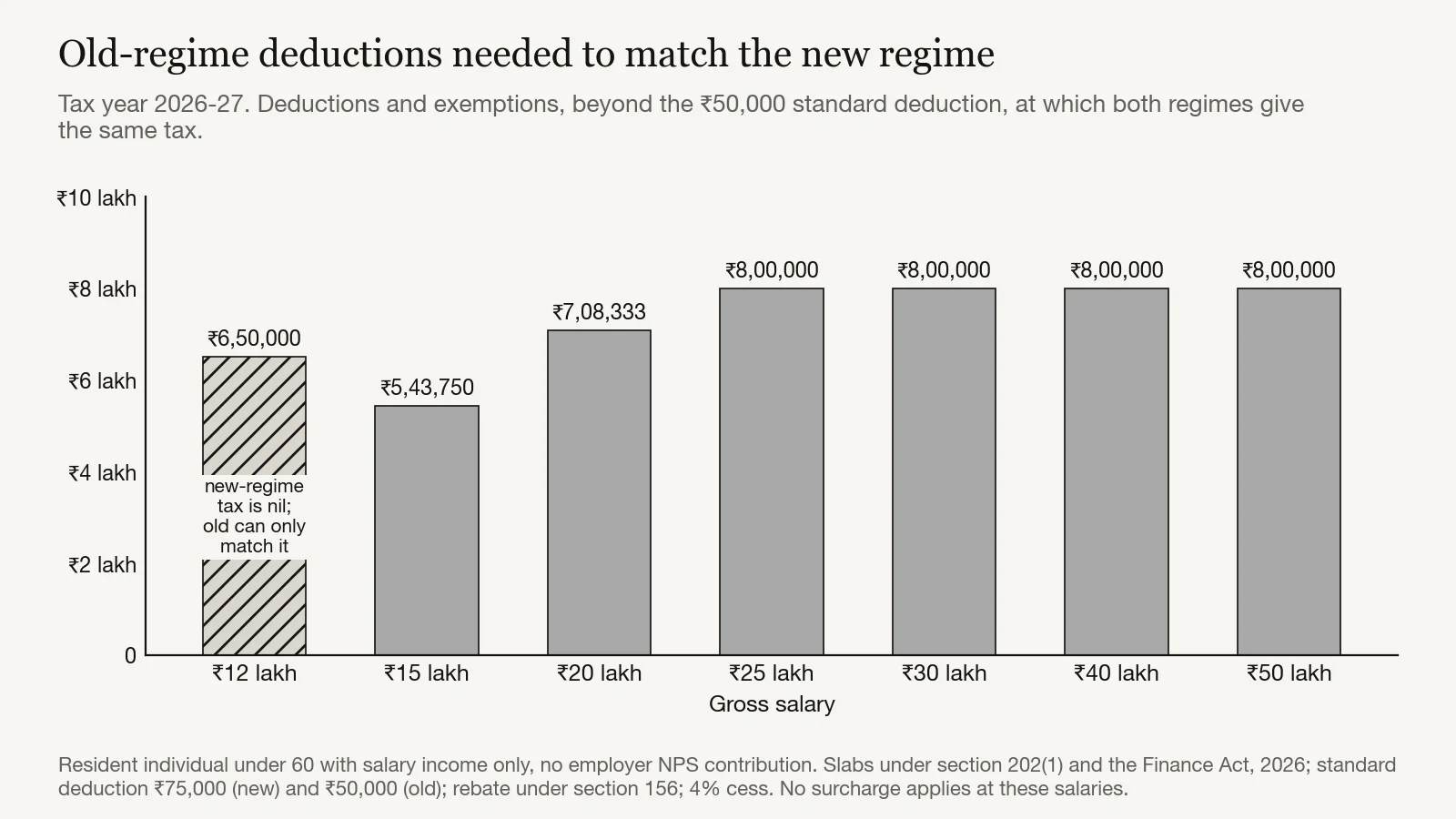
The ₹8 lakh figure stops moving from a salary of ₹24.75 lakh, where both regimes tax the last rupee at 30%. The reason is short. Above that point the new regime's wider slabs are worth ₹2,32,500 of tax before cess, and its extra ₹25,000 of standard deduction is worth another ₹7,500. Together that is ₹2,40,000, which is 30% of ₹8 lakh.
The ₹12 lakh row reads differently. The new regime's tax is already nil there, so the old regime can only equal it, which happens once deductions bring taxable income down to ₹5 lakh.
Just above the table there is an odd band. Once taxable income crosses ₹50 lakh the 10% surcharge applies, and old-regime deductions that pull income back to about ₹50 lakh shed nearly all of it. So at a salary of ₹55 lakh the break-even falls to ₹4,34,250, and by ₹60 lakh it is back to ₹7,69,250.
₹30 lakh with a home loan: every line
A self-occupied home loan alone does not reach the break-even at ₹30 lakh. It gets less than halfway. The illustrative case: gross salary ₹30 lakh, interest of ₹2 lakh or more on a loan for the house the person lives in, ₹1.5 lakh under section 123 (employee PF plus loan principal fill it), and a ₹25,000 health insurance premium.
The old regime comes to ₹1,32,600 more. Its deductions total ₹3.75 lakh against a break-even of ₹8 lakh.
Add ₹50,000 for parents' health insurance (both senior citizens) and ₹50,000 of own NPS contribution, and the total rises to ₹4.75 lakh. Old-regime taxable income becomes ₹24,75,000 and the tax ₹5,77,200, still ₹1,01,400 above the new regime. At these limits ₹4.75 lakh is the ceiling for someone whose only claims are these five. The remaining ₹3.25 lakh would have to come from HRA on a rented home in another city, education loan interest, donations or a loss on a let-out property.
The interest limit is ₹2 lakh whatever the size of the loan. It is per person, so co-borrowers who are co-owners each have their own limit. Whether to prepay the loan or keep investing is a separate calculation, though the regime changes the loan's after-tax cost.

₹30 lakh on rent, without a home loan
HRA is the one line large enough to carry a salaried person across ₹8 lakh. Take the same ₹30 lakh salary with a basic pay of ₹15 lakh, HRA of ₹7.5 lakh and rent of ₹60,000 a month in Bengaluru. The three HRA amounts are ₹7,50,000 received, ₹5,70,000 of rent above 10% of basic (₹7,20,000 less ₹1,50,000), and ₹7,50,000 at 50% of basic. The lowest, ₹5,70,000, is exempt.
The new regime's ₹4,75,800 sits between the two. With ₹7.45 lakh of deductions the old regime is ₹17,160 higher; with ₹8.45 lakh it is ₹14,040 lower. So the margin is thin here. Every ₹1,000 of deduction on either side of the break-even moves old-regime tax by ₹312.
The rent has to be paid, and shown. An employee claiming HRA gives the employer the landlord's name and address in Form 124, and the landlord's PAN where the year's rent is above ₹1 lakh; rule 205 of the 2026 Rules adds a declaration of any relationship with the landlord.
₹25 lakh: what changes the tax, legally, in each regime
In the new regime at ₹25 lakh, the inputs that move the tax are the ones the employer's salary structure controls. With nothing but the standard deduction, taxable income is ₹24,25,000 and the tax is ₹3,19,800.
The middle column assumes basic pay of ₹12.5 lakh and an employer who offers NPS in the pay package. The third assumes HRA of ₹6.25 lakh and rent of ₹40,000 a month in Pune, an exemption of ₹3,55,000 (rent of ₹4,80,000 less ₹1,25,000). Its deductions total ₹5.8 lakh. That is short of ₹8 lakh.
The facts behind each line:
- Employer's NPS contribution. Up to 14% of basic plus dearness allowance is deductible in the new regime (10% in the old, for a private employer). It is part of the cost of employing you, so cash salary falls by the same amount, and the money sits in NPS under PFRDA's exit rules until retirement.
- Employer's provident fund contribution. It is not taxed as salary. The cap is ₹7.5 lakh a year on the employer's contributions to provident fund and NPS, counted together with any superannuation fund; anything above it is a taxable perquisite (section 17). The Finance Act, 2026 rewrote paragraph 6 of Part A of Schedule XI and, with it, dropped the older parallel limit of 12% of salary from 1 April 2026.
- Perquisites. A benefit provided in kind, such as a car or accommodation, is taxed at the value the Rules assign to it. Which benefits are on offer is the employer's policy.
- In the old regime only. Each line of the earlier table, within its limit. Above a taxable income of ₹10 lakh, ₹1.5 lakh of deductions changes the tax by ₹46,800 including cess, and that counts only if total deductions end up beyond the break-even.
ELSS when you are in the new regime
An ELSS fund gets no deduction in the new regime. Section 202(2) switches off section 123, and ELSS units qualify only through that section's schedule. That is the whole change.
What is left is an equity fund with a statutory lock-in: each instalment is locked for three years from its own date, so an SIP unlocks month by month. Gains are taxed like those of any equity-oriented fund, at 12.5% on long-term gains above ₹1.25 lakh a year across all your equity holdings, and every ELSS redemption is long-term because of the lock-in. Returns depend on the market, and nobody can promise them.
In the old regime, ELSS competes with everything else in the ₹1.5 lakh. An employee whose PF is deducted at 12% of a ₹12.5 lakh basic has already used the whole limit, and a further ELSS purchase adds no deduction there either. Existing ELSS units stay locked until their three years are up whichever regime you file under.
Whether an equity fund with a lock-in suits you once the deduction is gone is a question about your portfolio. This guide does not answer it.
Selling mutual funds: the regime does not change the rates
Capital gains on mutual funds are taxed at the same rates in both regimes. Equity-oriented funds pay 20% on short-term gains and 12.5% on long-term gains above ₹1.25 lakh (sections 196 and 198), and debt funds bought on or after 1 April 2023 are taxed at your slab rate, where the regime's slab table does apply. The old regime's deductions under Chapter VIII (the ₹1.5 lakh, health insurance and the rest) cannot be set against equity gains taxed at the special rates.
The full rate table for every fund type is in consolidating 17 mutual funds into 5, and the way to use the ₹1.25 lakh each year is in harvesting long-term gains before 31 March.
How the choice is made with the employer and in the return
A salaried person with no business or professional income chooses afresh every tax year, and the choice that counts is the one in the return. There are two steps.
With the employer. Payroll asks at the start of the year which regime to use for deducting tax, and the salary certificate in Form 130 records whether the employee is opting out of section 202(1). Section 392 tells the employer to deduct at the rates in force and says nothing about regimes, and section 202(1) makes the new regime's rates apply unless the option is exercised. The income-tax portal's guidance, written for the same option under the 1961 Act, says that with no intimation the employer deducts under the new regime, and that what you tell your employer does not amount to exercising the option. We know of no CBDT circular that restates this under the 2025 Act; the Act is built the same way.
In the return. Section 202(4) and rule 136 say the option for the old regime is exercised in the return of income filed under section 263(1), which means a return filed by the due date. For a salaried person filing ITR-1 or ITR-2 the due date for tax year 2026-27 is 31 July 2027; the Finance Act, 2026 moved people with business or professional income whose accounts need no audit, and partners of such firms, to 31 August, and a salaried person with no such income stays in the 31 July row. A belated return, which can be filed until 31 December 2027, is filed under the new regime. No separate form is involved for a salaried person.
So the regime in the return can differ from the one payroll used. If it does, the tax deducted during the year will not match. A shortfall is paid with the return (with interest, where the advance tax rules apply), and an excess comes back as a refund.
Both calculations take a few minutes with the slab tables above. A tracking sheet that already lists PF and loan statements supplies most of the inputs.
Frequently asked questions
Old or new tax regime for a 30 lakh salary with a home loan?
At ₹30 lakh the two regimes give the same tax when old-regime deductions, beyond the ₹50,000 standard deduction, total ₹8 lakh. A self-occupied home loan gives at most ₹2 lakh of interest. With ₹1.5 lakh of investments and ₹25,000 of health insurance the total is ₹3.75 lakh, and old-regime tax is ₹6,08,400 against ₹4,75,800 in the new regime for tax year 2026-27. The old regime gives less tax only if HRA or other deductions take the total past ₹8 lakh.
Old or new tax regime: which gives less tax for a salaried person in 2026-27?
It turns on one number: your total old-regime deductions and exemptions other than the standard deduction. The old regime gives less tax above ₹5,43,750 at a ₹15 lakh salary, ₹7,08,333 at ₹20 lakh, and ₹8,00,000 from ₹25 lakh to ₹50 lakh. Below those totals the new regime gives less, and up to ₹12.75 lakh of salary its tax is nil.
How can a salaried person earning 25 lakh cut tax legally in India?
In the new regime, tax on ₹25 lakh is ₹3,19,800. The items that reduce it are an employer's NPS contribution (deductible up to 14% of basic pay) and the employer's provident fund contribution within the ₹7.5 lakh combined cap. In the old regime the tax falls with HRA, the ₹1.5 lakh investment limit, health insurance, home loan interest and own NPS, and those need to total more than ₹8 lakh before the old regime gives less tax than the new.
Is ELSS still worth it if I am on the new tax regime?
ELSS gets no deduction in the new regime. It remains an equity fund with a three-year lock-in on each instalment, taxed at 12.5% on long-term gains above ₹1.25 lakh a year like any equity fund, with returns that depend on the market. Without the deduction, the tax rules treat it like other equity funds, and whether it suits you is a portfolio question.
Can I switch between the old and new tax regime every year, even if my employer used the other one?
Yes, if you have no business or professional income. The new regime applies by default each year, and you opt for the old regime in the return itself, provided it is filed by the due date (31 July 2027 for tax year 2026-27). What you declare to payroll decides only the tax deducted from salary; any difference is settled as a refund or a payment with the return. A belated return is filed under the new regime.
Is HRA or home loan interest allowed in the new tax regime?
No for HRA and for interest on a self-occupied house. Interest on a loan for a let-out house can still be deducted from that house's rent in the new regime, but a resulting loss cannot be set against salary.
How much tax will I pay if I sell my mutual funds, and does the regime matter?
Equity fund gains are taxed at 20% if the units were held twelve months or less and at 12.5% on long-term gains above ₹1.25 lakh a year, plus cess, in both regimes. Debt fund units bought since April 2023 are taxed at your slab rate, so for those the regime's slab table applies.
Related guides
- Prepay a loan or keep investing: home, education and car loans after tax
- Idle cash and the emergency fund: where to keep it, after tax
- Harvesting long-term gains before 31 March, lot by lot
- Consolidating 17 mutual funds into 5: exit loads, capital gains and the order of operations
- Retiring early: the money needed at 45 or 50, and the EPF, PPF and NPS rules
- Tracking every investment in one place: what each statement covers
Sources: Income-tax Act, 2025 (No. 30 of 2025), in force from 1 April 2026: sections 17(1)(h), 19, 21, 22, 24, 93, 109, 123 and Schedule XV, 124, 125, 126, 129, 133, 153, 156, 196, 198, 202, 263 and 392, and Schedule III; Finance Act, 2026 (No. 4 of 2026, assented to on 30 March 2026): section 3 and Part I-B of the First Schedule (old-regime rates, surcharge, marginal relief and cess for tax year 2026-27), section 38 (interest limit in section 22), section 56 (section 202), section 66 (due dates under section 263) and section 127 (provident fund changes in Schedule XI); Memorandum explaining the provisions in the Finance Bill, 2026; Income-tax Rules, 2026 (G.S.R. 198(E) of 20 March 2026), rules 136, 204, 205, 279 and 280 and Forms 124 and 130, with the corrigendum G.S.R. 286(E) of 16 April 2026; income-tax e-filing portal help page for salaried individuals and its FAQs on the new and old regimes; Equity Linked Savings Scheme, 2005. Tax figures are for a resident individual under 60 with salary income only and are illustrative. Corpus has applied to SEBI for registration as an investment adviser. This page explains how the rules and statements work and does not recommend any scheme. Investment in securities market are subject to market risks. Read all the related documents carefully before investing.
This is the lead-generation form
Get info from your blog visitors for lead funnel
Corpus
Guides on reviewing a mutual fund portfolio in India: reading your CAS, overlap, commission, what advice costs and who may legally give it. Written by the Corpus team.
Visit Site