Your mutual fund has lagged for three years: the questions to answer before you exit or wait
Questions to answer from public disclosures and your CAS when a fund has trailed its benchmark for three years. Plus SIP pauses...

Contents
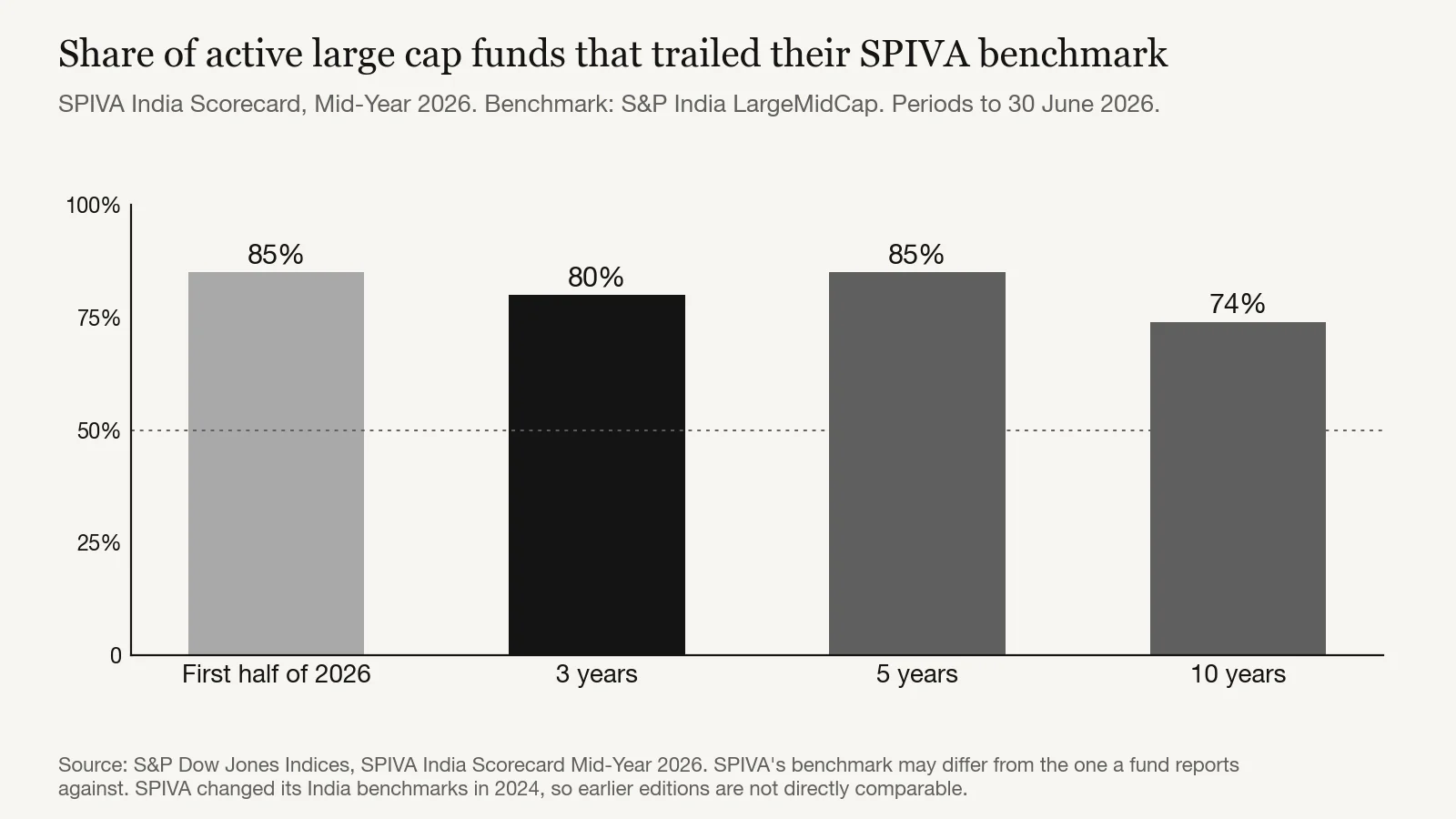
Three years of trailing the benchmark is common among active large cap funds. S&P Dow Jones Indices' SPIVA India scorecard for mid-year 2026 found that 80% of actively managed large cap funds had underperformed the S&P India LargeMidCap index over three years to 30 June 2026, 85% over five years and 74% over ten. (SPIVA's benchmark includes mid caps, so it is not the index your fund reports against.) So if yours is one of them, the useful question is less "is it bad" and more "is the reason for the gap something that is likely to persist".
Nobody can answer that with certainty, including the fund manager.
What you can do is work through a set of questions whose answers are public, in an order that rules out the boring explanations first. This guide lists them and where each answer sits. It gives no verdict on any fund. Corpus has applied to SEBI for registration as an investment adviser. This guide explains how the rules and the statements work; it does not recommend any scheme.
1. Lagged against what?
Start with the comparison itself, because a lot of "underperformance" is a wrong comparison.
Every scheme has to be measured against the Total Return Index (TRI) version of its benchmark, the one that adds back dividends; SEBI made that the rule in 2018. If you compare your fund with the plain Nifty 50 or Sensex figure in a news app, the benchmark is understated by the dividend yield and the fund looks better than it is. And a mid cap fund measured against the Nifty 50 tells you nothing either way.
One place to see this is AMFI's fund performance page (amfiindia.com, under research information). SEBI requires it to show every scheme's return against its benchmark TRI as a CAGR over one, three, five and ten years and since inception, for every plan, updated daily. Two things to check while you are there:
- Plan. Regular plans carry distribution costs that direct plans do not, so a regular plan trails its own direct twin every year by roughly the difference in expense ratios. If your folio is in a regular plan, part of what you are seeing is commission (the guide on regular vs direct plans shows how to put a rupee number on it). Compare the plan you actually hold.
- Category, as well as benchmark. Sort the page by category. If most funds in the category trailed the benchmark by a similar margin, the gap says more about the category than about your manager.
Under a SEBI circular of January 2025 fund houses also publish an information ratio for every equity scheme, daily, on their websites and AMFI's. It is the fund's return above its benchmark divided by how much that excess return jumps around. A negative figure says the same thing as the CAGR table. What it adds is how steady the gap has been.
2. Over which windows?
Any three-year number is one start date and one end date. Move either by a few months and the answer can change sign, especially after a sharp rally or fall that the fund caught early or late.
Rolling returns fix this by computing the three-year return for every possible start date (say every month for the last seven or ten years) and showing the whole spread. A speaker in NISM's Edubyte investor-education series in January 2026 summed it up: "Point-to-point returns are unreliable." AMFI's investor site has an explainer on trailing and rolling returns. SEBI does not require fund houses to publish rolling returns, so some factsheets carry them and some do not, and the paid tools that compute them use different windows. What to look for is the share of rolling windows in which the fund beat its benchmark, and whether the recent windows are worse than the fund's own history or in line with it.

The chart is illustrative.
So a fund can be behind on today's three-year number and ahead in most three-year windows over its life; or it can be behind in nearly every window, which is a different situation.
3. Is it still the same fund?
A track record belongs to a manager running a mandate at a certain size, and any of these can change. Check whether one did during the three years.
Manager. A fund manager change is announced by an addendum on the fund house's website; there is no requirement to write to each unitholder, and it gives you no special right to exit. The Scheme Information Document shows each manager's tenure on the scheme. Advertisements that show performance have to footnote it if the same manager did not run the scheme for the whole period. If the three bad years are mostly someone else's three years, the record you are judging is no longer the current manager's.
Mandate. SEBI's February 2026 circular redrew several equity categories and gave existing schemes six months, to late August 2026, to comply. Changes made only to fit the new categories (name, objective, benchmark) were declared not to be changes in fundamental attributes. So a scheme you have held since 2023 may now have a different name or benchmark from the one it was measured against for most of your holding period, without the no-load exit window that a change in fundamental attributes brings. The solution-oriented category (retirement and children's funds) was discontinued and those schemes are to be merged into similar ones.
Fundamental attributes. A change in a scheme's type, investment objective, asset allocation ranges or the fee and expense structure in its offer document is a different matter (a TER change within the regulatory limits is not one of these). Under regulation 22(9) of the SEBI (Mutual Funds) Regulations, 2026, every unitholder has to be told in writing (email or SMS counts) and offered an exit at NAV with no exit load; SEBI's master circular sets that window at no less than 30 calendar days. Mergers count as such a change for the scheme being merged. During that window, units still inside the scheme's exit load period can be redeemed without the load. Capital gains tax applies as usual.
Size. A fund that has grown several times over in three years, especially in mid and small caps, is a different machine. Since March 2024 mid cap and small cap funds publish stress test results (the number of days it would take to sell 25% and 50% of the portfolio pro rata, after setting aside its least liquid 20%), and AMFI hosts them on its risk parameters page. In 2023 and 2024 some small cap funds limited lump sum inflows; the press read that as a sign the funds were finding it harder to deploy new money.
4. Did the cost change?
Under the 2026 regulations the maximum base expense ratio has slabs that fall as a scheme grows (2.10% on the first ₹500 crore of an active equity scheme, stepping down to 0.95% beyond ₹50,000 crore). Fund houses publish every scheme's total expense ratio daily on their websites and on AMFI's TER page, which lets you see month by month whether your plan has become cheaper or dearer. A change in the base expense ratio needs an email or SMS at least three working days before it takes effect, unless the change comes from the scheme's size moving it into a different slab, up or down. So a shrinking scheme's ratio can rise with no notice.
As a rough guide, a gap of one to two percentage points a year against the benchmark is in the range a regular plan's total expense ratio can account for on its own.
Four points cannot be.
5. What does it hold now?
The portfolio is public. Every scheme's full holdings, with ISINs, go up on the fund house's website and AMFI's within 10 days of each month end, with the portfolio turnover ratio as a footnote for equity schemes. Fund houses also keep a scheme dashboard (required since 2016) and, from 2026, publish monthly how much their own schemes overlap category by category.
Things worth reading in the holdings:
- Concentration. The share of the top ten stocks, and of the largest sector, against the benchmark's. This works both ways: a fund far more concentrated than its benchmark will lag hard when its sectors are out of favour and lead hard when they are in.
- Drift. A flexi cap fund that has quietly become a large cap fund, or a large cap fund carrying the maximum it may in mid caps, is taking a different bet from the one you bought.
- Turnover. A turnover ratio far above the category's means more trading. Brokerage and exchange charges now appear in the total expense ratio (on top of the base ratio), but the price impact of buying and selling does not show in any disclosed figure.
- Overlap with the rest of your portfolio. If the fund holds the same large positions as your other funds, the overlap guide shows how much of your portfolio actually changes if this fund goes.
Ratios such as standard deviation, Sharpe ratio, beta and capture ratios appear in many factsheets. Outside the mid and small cap risk disclosure they are voluntary, and each fund house picks its own period and risk-free rate, so figures from two fund houses are often not comparable. The information ratio is the exception, because SEBI fixed the method.
6. Does recent leadership persist?
Part of the urge to switch is the belief that this year's leading funds will stay ahead. The evidence in India says they mostly do not. FundsIndia's October 2026 study (as reported by Moneycontrol) found that on average only 21% of equity funds in the top quartile stayed in the top quartile over the following five years, and 26% over three.
Bottom-quartile positions are not fixed either.
7. What would leaving cost?
Any redemption is a sale, and so is a switch to another scheme of the same fund house. On equity-oriented funds in tax year 2026-27, gains on units held 12 months or less are taxed at 20%; gains on units held longer at 12.5% above ₹1.25 lakh a year (one pool with listed shares and REIT and InvIT units), plus surcharge where applicable and 4% cess. Each SIP instalment is a separate lot with its own dates, and an exit load may apply to lots inside the scheme's load window. The guide on consolidating a portfolio works through the arithmetic lot by lot. There is no cost to stopping further SIPs into the fund; the existing units stay where they are.
"The market is down: should I pause SIPs?"
This is a different question that tends to arrive at the same time. It is about the market, not the fund, and the data on it is about what investors did, not about what they should have done. A pause prompted by a gap in income, such as a layoff, is a different case, covered under the size of an emergency fund.
At the end of September 2026 the Nifty 50 was about 13% down for the calendar year, with its sharpest monthly fall in March. In March and April 2026 slightly more SIPs closed than opened (a reported stoppage ratio of about 101%). By September the ratio was 78.5%: 63.26 lakh new registrations against 49.68 lakh SIPs discontinued or matured, and monthly SIP contributions of ₹32,490 crore, the highest AMFI has reported. In the previous fall, from September 2024 to March 2025, the ratio ran between 109% and 128% from January to March 2025, though part of that was the registrars cleaning out old SIP records (as was most of April 2025's very high figure). The "stoppage ratio" quoted in news reports counts matured SIPs and SIPs cancelled for failed debits along with people who chose to stop, so it overstates deliberate stopping.
What stopping or pausing involves, mechanically:
- A pause is a fund house facility with its own rules, commonly up to three or six monthly instalments, requested 10 to 30 days before the next debit depending on the fund house. SIPs registered through a stock exchange platform or MF Utility are often excluded. The SIP restarts on its own afterwards.
- A cancellation takes effect within two business days of a complete request (since December 2024); an instalment due inside those two days may still go through. Units already bought stay invested.
- A SIP whose debit fails three times in a row (twice for bi-monthly, quarterly or longer SIPs) is cancelled automatically, a rule in force since April 2024, and your bank may charge for each bounced mandate.
On behaviour, a widely quoted Indian estimate is Axis Mutual Fund's study of 2003 to 2022, which put the gap between what equity funds returned and what their investors earned at close to 5 percentage points a year, smaller for SIP investors. Motilal Oswal's estimate for calendar 2022, a volatile year in which SIP money kept flowing, found the gap briefly positive. Both are fund house research using estimated flows, not regulator data.
The checklist on one page
None of these answers is a decision. They narrow it.
The step from these answers to "exit" or "wait" for your portfolio is advice, and in India that comes from a SEBI registered investment adviser, or for scheme selection from an AMFI registered distributor.
Frequently asked questions
How do I know if my mutual fund is underperforming?
Compare the plan you hold with its benchmark's Total Return Index and with its category, on AMFI's fund performance page, over one, three and five years. Then look at rolling returns, which show whether the gap holds across many start dates or comes from one period.
Should I exit a mutual fund that has underperformed for three years?
That is a personal recommendation that this site does not make. Before deciding, check whether the manager, mandate, size or cost changed during the three years, what the fund holds now, and what tax and exit load each lot would carry. Over three years to June 2026, 80% of active large cap funds trailed the S&P India LargeMidCap index (SPIVA India).
What are rolling returns in mutual funds?
The return over a fixed period (for example three years) calculated for every possible start date over a longer history. They show how often and by how much a fund beat its benchmark, instead of relying on one start and end date.
Can I exit without an exit load if my fund changes its manager?
No. Manager changes are announced by addendum and carry no exit right. Changes in a scheme's fundamental attributes (type, objective, asset allocation or its stated fee structure) do, and so do mergers for holders of the scheme being merged: unitholders get at least 30 days to exit at NAV with no exit load. Capital gains tax still applies.
Is it okay to pause SIPs when the market falls?
Many fund houses let you pause a monthly SIP for a few instalments, and cancelling takes effect within two business days. Units already bought stay invested. Whether to pause is a decision about your own plan; the section above gives the SIP data from the 2025 and 2026 falls.
Related guides
- Consolidating 17 mutual funds into 5: exit loads, capital gains and the order of operations
- Mutual fund overlap across your whole portfolio
- What a portfolio health check should cover, and why XIRR alone misleads
- Regular vs direct plans: what commission has cost you, in rupees
- Harvesting long-term gains before 31 March, lot by lot
- Idle cash and the emergency fund: where to keep it, after tax
Sources: S&P Dow Jones Indices, SPIVA India Scorecard, Mid-Year 2026 (data to 30 June 2026; large cap funds against the S&P India LargeMidCap); SEBI Master Circular for Mutual Funds, 20 March 2026, paras 1.2.2 and 1.9 (addenda, fundamental attributes and the 30-day exit window), 3.2 (mergers), 6.1 (monthly portfolio disclosure), 6.8.2 (scheme dashboard), 6.9 (scheme vs benchmark performance on AMFI's website), 6.10 (information ratio), 7.23 (TRI benchmarks), 11.2-11.4 (TER components, disclosure and notice of changes), 14.2 (performance in advertisements) and the SID format (fund manager tenure); SEBI circular of 17 January 2025 on information ratio; SEBI (Mutual Funds) Regulations, 2026, as amended to 10 October 2026, regulations 22(9), 66(7) and 67; SEBI circular of 26 February 2026 on categorisation and rationalisation of mutual fund schemes, paras 2.6.3, 2.6.7 and 2.6.8; AMFI fund performance, TER and risk parameters pages; AMFI, Mutual Funds Sahi Hai explainer on trailing and rolling returns; NISM Edubyte, 1-15 January 2026; FundsIndia study on persistence of top-quartile funds, October 2026, as reported by Moneycontrol and Cafemutual; AMFI monthly SIP data for March, April and September 2026 and January to April 2025, as reported by Cafemutual, Business Today and Angel One; NSE closing values of the Nifty 50 for 31 December 2025 and 30 September 2026; AMFI letter of February 2024 on stress tests for mid and small cap funds, and press reports of small cap inflow limits in 2023-24; AMFI advisory on auto-cancellation of SIPs from 1 April 2024, as reproduced in Taurus Mutual Fund's FAQ; HDFC, Canara Robeco and HSBC mutual fund SIP pause and cancellation forms (cancellation within two business days from 1 December 2024); Axis Mutual Fund, investor behaviour study 2003-2022, as reported by Cafemutual (September 2022); Motilal Oswal AMC, "The average equity investor outperformed their investments in 2022" (April 2023); Income-tax Act, 2025, sections 196 and 198. Corpus has applied to SEBI for registration as an investment adviser. This page explains how the rules and statements work and does not recommend any scheme. Investment in securities market are subject to market risks. Read all the related documents carefully before investing.
This is the lead-generation form
Get info from your blog visitors for lead funnel
Corpus
Guides on reviewing a mutual fund portfolio in India: reading your CAS, overlap, commission, what advice costs and who may legally give it. Written by the Corpus team.
Visit Site