Harvesting long-term gains before 31 March: using the ₹1.25 lakh exemption on your own mutual fund lots
How many units to redeem before 31 March to use the ₹1.25 lakh LTCG exemption, which lots FIFO takes, and when harvesting backfires...

Contents
Long-term gains on equity-oriented mutual funds are taxed at 12.5%, but only on the part above ₹1.25 lakh a person in each tax year. The allowance does not carry forward. A year in which you redeem nothing uses none of it, and on 1 April it resets to ₹1.25 lakh, unspent.
Harvesting means redeeming enough units before 31 March to book a long-term gain close to whatever is left of that ₹1.25 lakh, and, if you want to stay invested, buying back. The gain is booked with no tax, and the units you buy back carry today's NAV as their cost, so that slice of growth stays untaxed. This guide shows how to work out the number of units from your own statements and which choices the rules leave to you. The later sections cover where the idea stops working and how the same arithmetic applies when you need the money. It names no funds. Corpus has applied to SEBI for registration as an investment adviser. This guide explains how the rules and the statements work; it does not recommend any scheme.
What harvesting does, in rupees
Booking ₹1.25 lakh of long-term gain in a year when you have no other long-term gains costs no tax. The gain still goes in your return. If you buy back, your cost goes up by ₹1.25 lakh, so a later sale shows ₹1.25 lakh less gain. At 12.5% plus the 4% cess, the tax on that much gain is ₹16,250 (more if surcharge applies to you), which is the most one person's harvest in one year can take off a later tax bill.
Two conditions decide whether that saving is real. You must at some point redeem enough to have long-term gains above ₹1.25 lakh in a year; someone whose yearly gains will always stay under the allowance saves nothing by harvesting. And the exemption must still exist in that later year; it sits in section 198 of the Act, any Finance Act can change it, and nothing about tax years after 2026-27 has been announced.
The rules it runs on, for tax year 2026-27
The Income-tax Act, 2025 has applied since 1 April 2026, and it calls the April-to-March year a "tax year". For units of an equity-oriented fund (65% or more in listed Indian equity, which includes most equity funds, ELSS, Indian equity index funds, arbitrage and aggressive hybrid funds):
- A gain is long-term after twelve months of holding, counted lot by lot from each purchase date.
- Short-term gains are taxed at 20% (section 196). Long-term gains are taxed at 12.5% on the part above ₹1,25,000 (section 198). Both rates are before surcharge and the 4% cess. The Finance Act, 2026 left both rates and the exemption unchanged.
- The ₹1.25 lakh is one pool for the year, shared with long-term gains on listed shares and on REIT and InvIT units. Long-term gains on any of these that you sold through a broker this year have already used part of it.
- Units bought before 1 February 2018 still get the old grandfathering: the cost is the higher of what you paid and the NAV on 31 January 2018, capped at the sale value (section 90).
The full rate table for every fund type, debt and hybrid included, is in consolidating 17 mutual funds into 5.
Which units leave: oldest first, folio by folio
You choose the scheme, the folio and the number of units, and FIFO picks the lots. The redemption slip has no field for a purchase date, and the registrars match every redemption to the oldest units still in the folio, first in, first out. Since September 2026 the tax department's reporting format also tells the registrars to identify the units sold first in, first out when they report estimated gains for pre-filling your return and Annual Information Statement. The format does not mention folios, and you can correct the pre-filled figures before filing.
For units held in demat the rule is in the Act itself (section 67(7)(c)), and a 1998 CBDT circular, which continues under the 2025 Act, says FIFO applies account by account. Two demat accounts are two separate queues.
Statement-of-account folios work in a similar way: each folio is redeemed on its own, oldest units first. If you happen to hold one scheme in two folios, a redemption placed against one folio leaves the other untouched. That comes from how registrars process requests. The Act's FIFO rule covers only depository holdings, and we know of no provision or ruling on how two folios are treated for tax. It also only helps with purchases already sitting in separate folios, because units cannot be moved between your own folios without merging them into one queue.
In an SIP folio, FIFO usually works in your favour for harvesting. The oldest units are the ones most likely to be long-term and carrying a gain.
Working out how many units to redeem
The registrars' capital gains statements cover realised gains only. For units you still hold, you build the list yourself from two documents:
- The detailed CAS, which lists every purchase and redemption in each folio with its date, units and NAV. Reading your CAMS or KFintech CAS explains the layout.
- This year's realised gains and losses so far, plus losses carried forward: the capital gain statement from CAMS or KFintech for the current financial year, your broker's profit and loss statement for listed shares, and last year's return. Long-term gains already booked use up the ₹1.25 lakh. Long-term losses, booked this year or carried forward, are set off against your long-term gains first, and short-term losses not absorbed by short-term gains go the same way, so each rupee of those losses adds a rupee to the gain you can book before the ₹1.25 lakh runs out.
Then, for each folio:
- Strike out units already redeemed, oldest first. What is left is your list of open lots.
- Mark each lot long-term (held over twelve months on the day you plan to redeem) or short-term, and work out its gain per unit at the current NAV.
- Walk down from the oldest lot, adding up gains, until the total reaches the room left in your ₹1.25 lakh. The units up to that point are your number.
An illustrative folio, valued at a NAV of ₹100, with ten purchases of 1,000 units each:
With nothing else booked this year, lots 1 and 2 give ₹1,05,000 of gain. The remaining ₹20,000 needs 416 units of lot 3 (416 × ₹48 = ₹19,968). Redeeming 2,416 units, worth ₹2,41,600, books ₹1,24,968 of long-term gain and no tax.
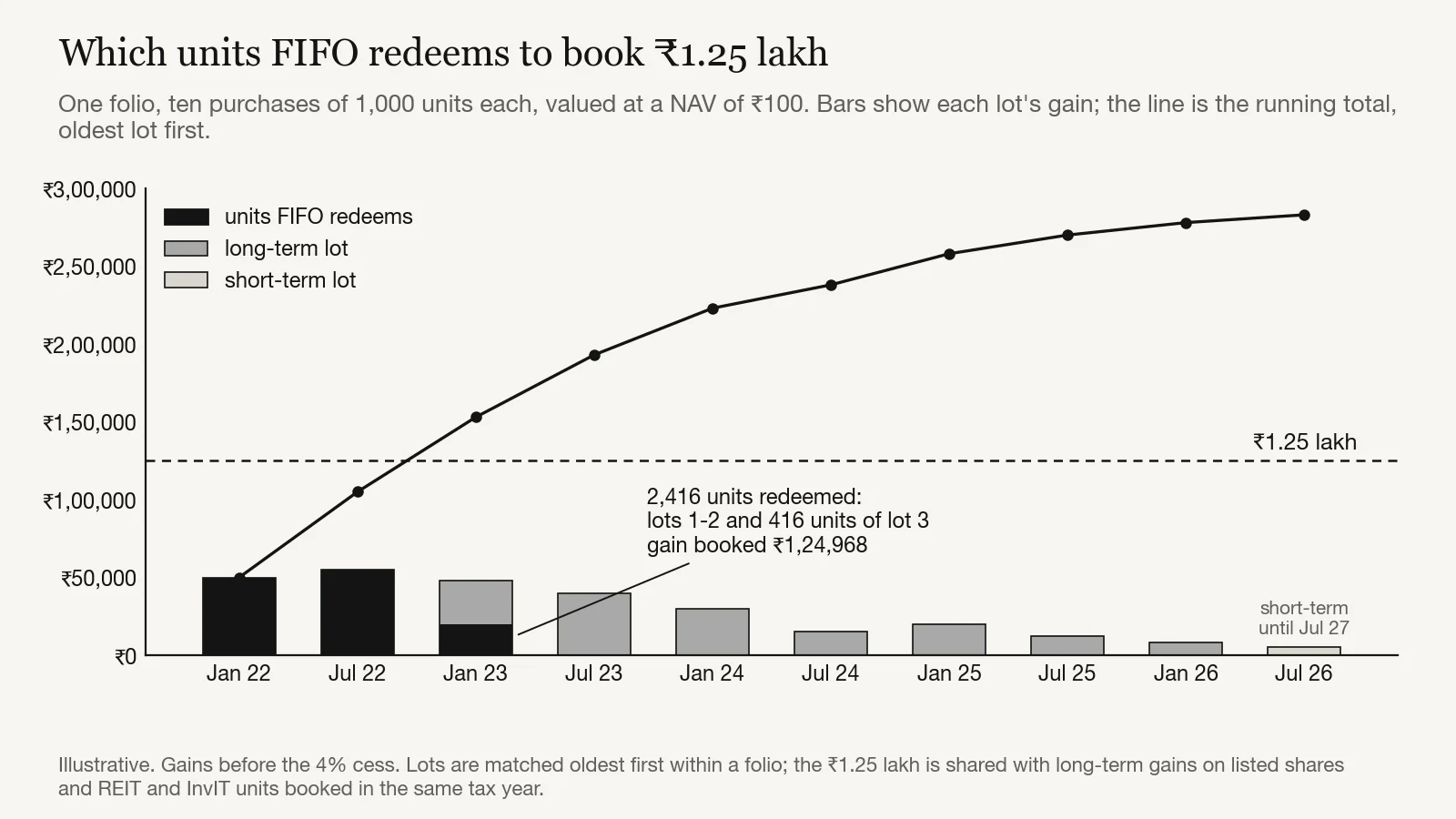
Place the redemption as a number of units. NAV moves between the day you calculate and the day the order is priced, and a rupee amount would redeem a different number of units and book a different gain. A small margin below the full ₹1.25 lakh also leaves room for a NAV that rises before the order is priced: in this example, each ₹1 rise adds ₹2,416 of gain, against a margin of ₹32.
If you hold several folios, the ₹1.25 lakh is shared across all of them. The folios whose oldest lots carry the largest gain as a share of their value book the allowance with the fewest rupees redeemed. Check, too, where each folio's queue turns short-term: once FIFO reaches a lot held twelve months or less, every further unit books a short-term gain taxed at 20%, or a short-term loss.
Buying back: what it costs and what it restarts
The units you redeem are priced at that day's NAV, and the money reaches your bank within three working days (SEBI's limit; equity schemes usually pay in two). A purchase is priced at the NAV of the day the money is available to the scheme, if it arrives by 3 pm, and otherwise at the next business day's NAV. So a sell and rebuy through your bank leaves the money out of the market for two to four business days, and the market can move either way in that time.
The direct costs are small: stamp duty of 0.005% on the purchase and STT of 0.001% on the redemption, about ₹14 on the ₹2.42 lakh example. The larger effects are on the new lot:
- it is a new lot with a new date, so it is short-term again for twelve months;
- if the scheme has an exit load, the new lot starts a new load window, so check the scheme's current load before buying back into it;
- ELSS units bought back start a fresh three-year lock-in. Under the old tax regime the purchase counts towards the ₹1.5 lakh deduction under section 123 (the old 80C); under the new regime, the default, it does not.
The Act has no wash-sale rule, so a gain or loss booked on a redemption counts even if you buy the same scheme back the same week. The narrow exception is section 175(9), for units sold after a bonus allotment. The general anti-avoidance chapter of the Act does not apply where the tax benefit of an arrangement is ₹3 crore or less in a year (rule 128 of the Income-tax Rules, 2026), far above anything a ₹1.25 lakh harvest can produce. We know of no court ruling specific to mutual fund sell-and-rebuy, either way.
Units in a regular plan can also be switched to the direct plan of the same scheme. SEBI's master circular (para 11.7.3) bars an exit load on a switch between the regular and direct plans of one scheme, and the switch is taxed like any redemption, so it can use the same allowance. Regular vs direct plans shows how the commission in each plan works out in rupees.
Losses: when booking one helps and when it wastes the exemption
A short-term capital loss can be set against short-term or long-term gains. A long-term loss can only be set against long-term gains (section 108). Two features of the law catch people out.
The set-off is compulsory. The Act says a loss "shall be set off" against that year's gains, and only what is left over can be carried forward. And it happens before the ₹1.25 lakh is applied. If you have ₹1 lakh of long-term gains and book a ₹60,000 loss, the loss reduces the gain to ₹40,000, which was untaxed anyway. The loss has saved nothing, and it is gone.
So a loss is worth booking in a year when it will absorb gains that would otherwise be taxed: short-term gains at 20%, or long-term gains above ₹1.25 lakh. Losses left over carry forward for eight tax years, but only if the return for the year of the loss is filed by its due date (31 July for most salaried people filing ITR-2; sections 111, 121 and 263). A late return for that year loses them.
FIFO makes loss harvesting harder than it sounds. In an SIP folio, the lots below cost are often recent ones, bought near a peak, and you cannot reach them without first redeeming every older lot in that folio, gains and all. Loss harvesting is practical mainly where a whole folio is below cost, or where the loss-making purchases sit in a separate folio or scheme. The guide on consolidation works through the order when gains and losses fall in the same year.
Where harvesting does nothing, or backfires
Debt funds bought on or after 1 April 2023. Gains on them are taxed at your slab rate whenever you sell, however long you hold (section 76). There is no exemption to use.
Debt funds bought before April 2023. Selling and buying back changes their treatment for the worse. The old units qualify for 12.5% after 24 months (12 if listed); the units you buy back are new units, taxed at slab for good.
Hybrid funds with under 65% in Indian equity and no more than 65% in debt, and gold, silver and international funds of funds. These are long-term after 24 months and taxed at 12.5% with no ₹1.25 lakh exemption (listed ETFs of this kind turn long-term after 12 months). Booking a gain early only changes when you pay. Hybrid funds with more than 65% in debt, bought on or after 1 April 2023, are taxed like the debt funds above.
Moving units to a spouse or a minor child. Gains on assets you give a spouse without adequate consideration are added to your income, and a minor child's investment income is added to the income of the parent with the higher income, whoever gave the money (section 99). Each person's ₹1.25 lakh applies only to income taxed in their own hands. Adult children and parents are outside that rule, but units given to them become theirs.
NRIs and the basic exemption. A resident individual or HUF with low other income can also set equity gains against any unused part of the basic exemption (the ₹4 lakh first slab under the new regime) before the special rates apply (sections 196(2) and 198(3)). Non-residents cannot. Neither can anyone use the rebate under section 156 against tax on equity long-term gains (section 198(7)), and under the new regime the rebate is capped at tax on slab-rate income, so it does not touch 20% short-term gains either. Whether large capital gains also push your income above the ₹12 lakh rebate limit is a point commentators disagree on; check it with a chartered accountant if you are close to that line.
The deadline: 3 pm on a business day, and why not 31 March
A gain belongs to the tax year in which the transfer happens, and for a redemption that is the day whose NAV it gets. Under SEBI's master circular, a request received before 3 pm on a business day gets that day's closing NAV. After 3 pm, or on a holiday, it gets the next business day's NAV. A payout that arrives in April leaves the gain in the year of the NAV date, and a 3.05 pm request on the last business day of March moves it into the next year.
31 March 2027 is a Wednesday, and the exchanges have not yet published their 2027 holiday list. 31 March 2026 was a market holiday (Mahavir Jayanti), and Good Friday falls on 26 March in 2027. Apps and brokers often close their own cut-off earlier than 3 pm. Placing the order in the second or third week of March avoids all of that.
Advance tax, if you book more than ₹1.25 lakh
A harvest kept within the allowance creates no tax and nothing to pay in advance. If you book more, the tax on the excess counts towards advance tax, which is due from anyone whose tax for the year is ₹10,000 or more (section 404; residents aged 60 or over with no business or professional income are exempt under section 403(3)). Section 425(4) waives interest for deferment where the shortfall comes from capital gains that arose later in the year, provided the tax on them is paid in the remaining instalments: a gain booked in January goes into the 15 March instalment, and a gain booked between 16 and 31 March has to be paid by 31 March.
If you need the money: ₹25 lakh in 18 months
Eighteen months from November 2026 runs to May 2028, which touches three tax years: 2026-27, ending 31 March 2027; 2027-28; and the start of 2028-29. If the rules stay as they are, that is up to three ₹1.25 lakh allowances per person.

We know of no SEBI or AMFI rule that sets an order for redeeming towards a goal, and the order is a choice about your own plan. How much of money needed in 18 months should stay in equity is a question about that plan too, and this guide does not answer it. The tax side can be laid out. What each rupee withdrawn costs depends on the lot it comes from:
- units that would book a loss carry no tax on the redemption, though they may carry an exit load, and the loss is set off against that year's other gains first, which saves tax only where those gains would otherwise be taxed;
- long-term equity units cost nothing up to the year's ₹1.25 lakh, and the lower a lot's gain per rupee of value, the more cash it releases inside the allowance;
- units still inside an exit load window cost the load (often 1% where it applies), on top of any tax;
- long-term equity units above the allowance cost 12.5% of the gain, short-term ones 20%;
- debt fund units bought since April 2023 cost slab rate on the gain whenever they go.
Redemptions spread across tax years can use each year's allowance, and the units still invested stay exposed to the market until they are redeemed. Money moved early into a debt fund to wait for the purchase earns gains taxed at slab, and a systematic transfer plan is a string of redemptions, each with its own tax and load. What a portfolio health check should cover sets out how to see which lots and folios you hold before deciding any of this, and a tracking sheet with a column for each lot's holding date shows when it turns long-term.
Frequently asked questions
What is LTCG harvesting in mutual funds?
Redeeming equity fund units before 31 March to book long-term gains up to the ₹1.25 lakh that is untaxed each tax year, and usually buying back. The units bought back carry the current NAV as their cost, so the gain booked stays untaxed.
How do I calculate how many units to redeem for ₹1.25 lakh of gains?
List each folio's open lots from the detailed CAS, oldest first, with each lot's gain per unit at today's NAV. Work out the room left: ₹1.25 lakh, less long-term gains already booked this year (listed shares included), plus any losses that will be set off against the harvest. Add up the oldest long-term lots until the total reaches that figure, and place the redemption as a number of units.
Can I choose which units are redeemed?
Within a folio, no. Redemptions take the oldest units first. You choose the scheme, the folio and the number of units. Demat holdings follow the same rule account by account.
Is there a wash-sale rule in India for mutual funds?
No. A gain or loss booked on a redemption counts even if you buy the same scheme back straight away. The new units start a new holding period and, where the scheme has one, a new exit load window.
Does a capital loss reduce tax if my long-term gains are below ₹1.25 lakh?
Not on those gains. The set-off is compulsory and comes before the exemption, so a loss set against long-term gains that were already untaxed is used up with no tax saved. A loss saves tax in a year with short-term gains or long-term gains above ₹1.25 lakh, and a return filed on time carries any balance forward for eight years.
What is the last day for LTCG harvesting in tax year 2026-27?
The redemption has to be priced at a NAV dated on or before 31 March 2027: a request before 3 pm on a business day gets that day's NAV. The 2027 holiday list is not yet out, and 31 March 2026 was a holiday, so an order placed by mid-March leaves room for a holiday or an early platform cut-off.
Can NRIs do LTCG harvesting?
Yes, the ₹1.25 lakh exemption applies to non-residents as well. They cannot use the unused basic exemption against equity gains, which only residents can. The fund house deducts tax at source when an NRI redeems (section 393(2)), and fund houses' tax notes apply the 12.5% only to long-term gains above ₹1.25 lakh; each fund house sees only its own folios, so the amount deducted can differ from the tax due and the return settles the difference.
Related guides
- Consolidating 17 mutual funds into 5: exit loads, capital gains and the order of operations
- Reading your CAMS or KFintech CAS line by line
- Tracking every investment in one place: what each statement covers
- What a portfolio health check should cover, and why XIRR alone misleads
- Old or new tax regime for a salaried person in 2026-27
- Idle cash and the emergency fund: where to keep it, after tax
Sources: Income-tax Act, 2025 (No. 30 of 2025), in force from 1 April 2026: sections 2(101) (holding period), 3 (tax year), 67(1) and 67(7)(c) (charge of capital gains; FIFO for depository holdings), 70(1)(b), 73, 76 (specified mutual funds), 90(7)-(8) (grandfathering), 92(3), 99 (clubbing), 108, 109, 111 and 121 (set-off and carry-forward of losses), 123 and Schedule XV (old-regime deduction), 156 (rebate), 175(9) (bonus stripping), 178-184 (general anti-avoidance), 196, 197 and 198 (rates; ₹1,25,000 exemption; definition of equity oriented fund), 202 (new regime), 263 (return due dates), 393(2) (tax deducted at source for non-residents), 403, 404, 408, 424 and 425 (advance tax and interest), 536(2) (continuation of circulars and old losses); Income-tax Rules, 2026, rule 128; Finance Act, 2026, as summarised in the HSBC Mutual Fund tax reckoner for tax year 2026-27 and Tata Mutual Fund's post-Budget note of 20 February 2026; CBDT Circular No. 768 of 24 June 1998 (FIFO applied account-wise); DGIT (Systems) Notifications No. 1 and 2 of 2026 (SFT-2517 and SFT-2518 reporting formats, FIFO); SEBI Master Circular for Mutual Funds, 20 March 2026, paras 9.4.1-9.4.3 (cut-off times and applicable NAV), 15.3 (redemption payment within three working days) and 11.7.3 (no exit load on a switch between the regular and direct plans of a scheme); SEBI circular of 17 September 2020 (NAV on realisation of funds, from 1 February 2021); Indian Stamp Act, 1899, as amended by the Finance Act, 2019; CAMS redemption transaction slip; KFintech capital gain / loss statement page and HDFC Mutual Fund note on capital gains statements (realised gains only); Equity Linked Savings Scheme, 2005; exchange notices of the trading holiday on 31 March 2026. Corpus has applied to SEBI for registration as an investment adviser. This page explains how the rules and statements work and does not recommend any scheme. Investment in securities market are subject to market risks. Read all the related documents carefully before investing.
This is the lead-generation form
Get info from your blog visitors for lead funnel
Corpus
Guides on reviewing a mutual fund portfolio in India: reading your CAS, overlap, commission, what advice costs and who may legally give it. Written by the Corpus team.
Visit Site