Investing in US stocks from India: the fund route, the LRS route, GIFT City and RSUs, and how each is taxed for a resident in 2026-27
Funds, LRS and GIFT City as routes to US stocks, with TCS, capital gains, dividend credit and Schedule FA reporting...

Contents
A resident Indian can own US stocks in four ways: through an Indian mutual fund, fund of funds or ETF that invests overseas; by remitting money under the RBI's Liberalised Remittance Scheme (LRS) to a broker abroad; through a broker or fund in GIFT City; or as shares from a US employer's stock plan. The first is bought in rupees and taxed as an Indian fund that is not an equity fund. The other three leave you holding a foreign asset.
For US shares held directly, the tax has five parts. The bank collects 20% at source (TCS) on LRS remittances above ₹10 lakh a year, as a credit against your tax. Gains are taxed at 12.5% after 24 months and at slab rate before. The US withholds 25% of each dividend, and India taxes it at slab rate with credit for the US tax. Every holding goes into Schedule FA. And US estate tax can reach US shares above USD 60,000.
These are the rules in November 2026 for a person resident and ordinarily resident in India. The guide does not say which route to use or whether to invest abroad at all. Corpus has applied to SEBI for registration as an investment adviser. This guide explains how the rules and the arithmetic work; it does not recommend any scheme.
Indian mutual funds, funds of funds and ETFs that invest overseas
This route needs no remittance. You buy units in rupees and the fund holds the US shares or a US fund. But it has a ceiling.
SEBI's master circular for mutual funds (paragraph 13.11, as on 20 March 2026) caps the industry's holdings of overseas securities at USD 7 billion, with USD 1 billion for any one mutual fund. Overseas ETFs have a separate cap: USD 1 billion for the industry and USD 300 million for one mutual fund.
Whether a scheme takes fresh money today depends on where its fund house stands against those caps. SEBI's instructions went to fund houses through AMFI as letters and are known from press reports and scheme notices. As reported, subscriptions were stopped in early February 2022, allowed again from June 2022 up to the room each fund house had on 1 February 2022, and stopped for schemes investing in overseas ETFs from 1 April 2024. Since then schemes have opened when redemptions made room, and shut again. Several reopened in 2026 with a daily cap for each investor, and some closed within weeks. So the status changes. The scheme's latest notice on the fund house's website is the only statement of it on a given day.
ETFs listed in India that track a US index. These can still be bought on the exchange from another investor when the fund house cannot create new units, and that is where a premium comes from. Normally a market maker creates units when the traded price rises above the value of the holdings, and the gap closes. With creation shut, the price is whatever buyers will pay. SEBI makes the fund house publish an indicative NAV (iNAV) during trading hours. For an ETF on an international index it rests on the latest available data on the portfolio, so it can stand still while the overseas market is closed. The traded price against the iNAV is the premium, and it can vanish if creation resumes.
Costs and paperwork. The cost is the scheme's expense ratio, plus the expenses of the overseas fund underneath a fund of funds; an ETF adds brokerage and the bid-ask spread. No TCS applies and the LRS limit is untouched. The units are an Indian asset, so they stay out of Schedule FA and US estate tax does not reach them. Tax withheld abroad on the fund's dividends is paid by the fund, inside the NAV, and the unit holder has no foreign tax credit to claim.
Remitting under the Liberalised Remittance Scheme to an overseas broker
Under the LRS a resident individual may remit up to USD 2,50,000 in a financial year (April to March) for all permitted purposes together. Travel, education, gifts and investment share the one limit. PAN is mandatory.
What the scheme permits. An individual's investment abroad falls under the Overseas Investment Rules and Directions of 2022, which call it overseas portfolio investment. Listed foreign shares qualify. So do units of an overseas investment fund regulated in its home country, the heading US-listed ETFs come under.
What it bars. The LRS master direction does not allow remittances for margins or margin calls. The overseas investment directions rule out portfolio investment in derivatives (unless the RBI permits), unlisted debt instruments and commodities, and the RBI's questions and answers rule out trading in foreign exchange abroad. Banks may not lend to fund a capital account remittance. So an account funded under the LRS is a cash account, with no options, futures or borrowing against the shares.
Idle money: 180 days. Foreign exchange that is received, realised, unspent or unused has to be reinvested, or else brought back and surrendered to an authorised dealer within 180 days (paragraph A.17 of the master direction). Income on the investments can be kept and reinvested. Cash cannot sit idle with the broker beyond that.
What it costs. Each bank and broker prices these differently:
- The exchange rate. The bank sells dollars at its own rate, a mark-up over the interbank rate, and buys them back at a lower one.
- Bank charges. A remittance fee, the correspondent bank's charges abroad, and GST on the currency conversion.
- The overseas broker. Commission or a spread on each trade, and sometimes a fee to withdraw money.
- TCS. Above ₹10 lakh a year, a cash outflow that comes back through the tax return.
Fractional shares. Neither RBI direction uses the term, and we know of no RBI circular that does. A fraction is an entry in the broker's own books, and the broker's terms say what happens to it on a transfer out.
The GIFT City routes
Money sent to GIFT City's International Financial Services Centre (IFSC) for investment is an LRS remittance, inside the same limit. The master direction lets a resident open a foreign currency account there for any purpose the LRS permits.
Unsponsored depository receipts on NSE IX. Receipts on selected US stocks began trading on 3 March 2022. This route is closing. The exchange's circular of 24 July 2026 stopped new buy orders from 30 July 2026. Holders can sell until 29 January 2027, or convert into the underlying US shares until 20 January 2027 where the holding comes to a whole number of shares. Dealing ends on 1 February 2027.
Direct access through an IFSC broker. IFSCA's global access circular of 12 August 2025 lets a broker-dealer registered in the IFSC route client orders to exchanges abroad, itself or through a global access provider. You end up owning the US share itself. A resident client is held to what the LRS permits, so the bars on margin and derivatives apply here too.
Funds set up in the IFSC. The IFSCA (Fund Management) Regulations, 2025 provide for retail and non-retail schemes, and paragraph 24 of the RBI's overseas investment directions lets a resident individual buy their units within the LRS limit.
How the tax differs. For a resident, very little. TCS applies, because the money moves under the LRS. A resident is taxed in India on income from anywhere, and the Act's exemption for trades on an IFSC exchange (section 70(1)(r)) is written for non-residents. US shares bought through an IFSC broker carry the same 25% on dividends, the same Schedule FA entry and the same estate tax exposure as shares bought through a broker in the US. Units of an IFSC fund are a different asset: an interest in a fund set up in India. We know of no CBDT circular on how a resident's income from such a fund is taxed or whether its units count as assets outside India for Schedule FA; the fund's offer document is the place to look.
ESOPs and RSUs of a US employer
Shares from a US parent's stock plan arrive with no remittance. They are foreign shares from the day of allotment.
- At vesting or exercise. The value of the shares, less anything you pay, is a perquisite taxed as salary (section 17(1)(d)), measured at fair market value on the date the option is exercised, which for RSUs is in practice the vesting date. The Indian employer deducts tax on it, and plans commonly sell some shares to fund that.
- At sale. The cost is the value already taxed as salary (section 73), and the holding period runs from allotment (section 2(101)). After that the capital gains rules below apply.
- Under FEMA. The overseas investment directions put no ceiling on a remittance to acquire shares under an ESOP, though it counts towards the LRS limit. Sale proceeds fall under the 180-day rule.
Dividends, Schedule FA and US estate tax apply as they do to shares bought through a broker. The plan administrator's statement is the only record, as the guide to tracking every investment in one place explains.
TCS on the remittance: 20% above ₹10 lakh, and how it comes back
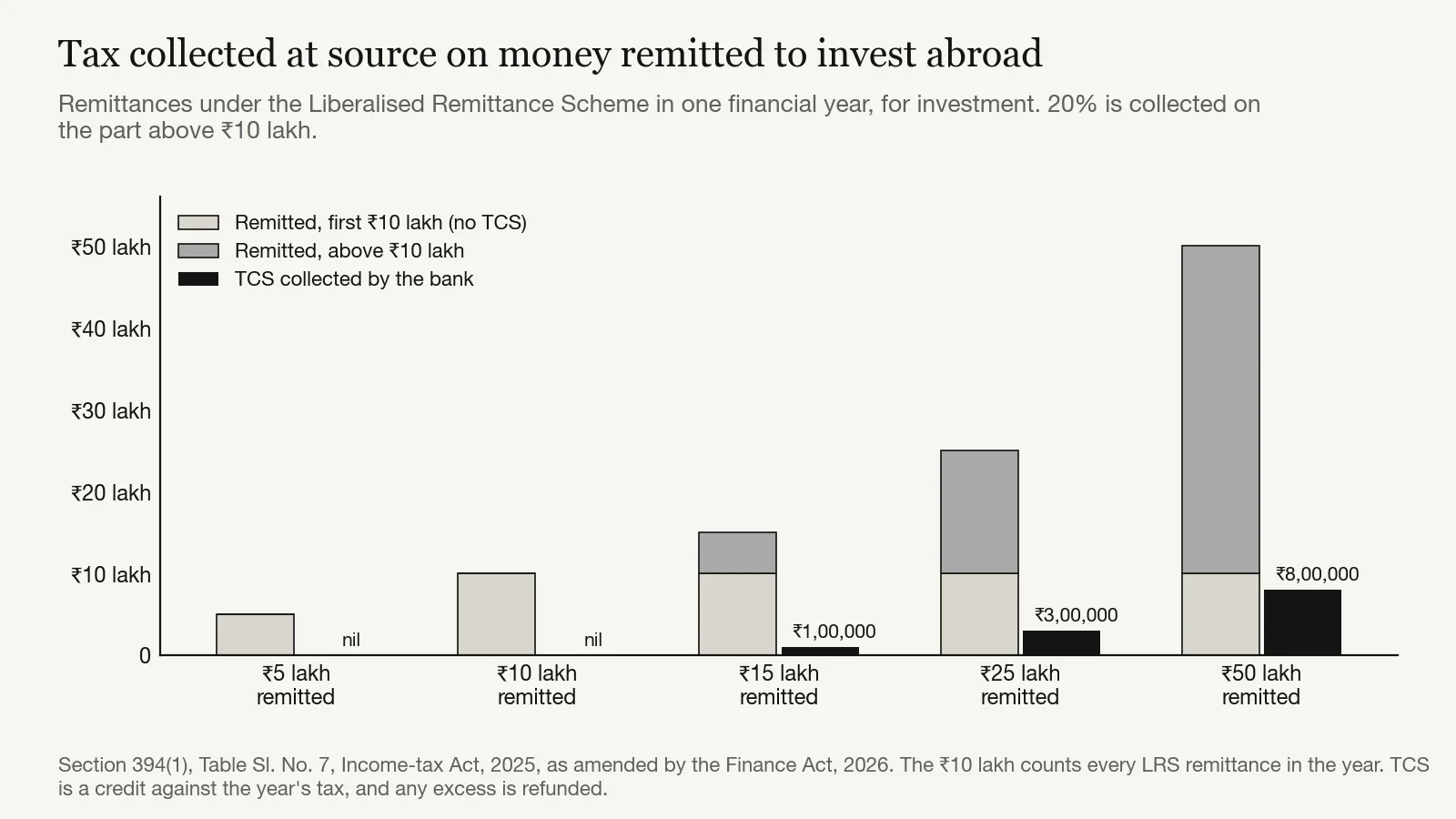
The bank collects tax at source once LRS remittances in a financial year cross ₹10 lakh. For investment the rate is 20% of the amount above ₹10 lakh (section 394(1) of the Income-tax Act, 2025, Table, serial number 7), and the ₹10 lakh counts every LRS remittance of the year, whatever its purpose.
The threshold was ₹7 lakh until the Finance Act, 2025 raised it to ₹10 lakh from 1 April 2025. The Finance Act, 2026 cut the rate for education and medical treatment from 5% to 2% and set overseas tour packages at 2%. It left the 20% for other purposes, investment included, alone.
TCS is not a final tax. Section 390(5) treats it as tax paid on behalf of the person it was collected from, and it comes back in one of three ways:
- Against salary TDS. An employee can give the employer the particulars of TCS collected in the year, and the employer counts it when deducting tax from salary (section 392(4)).
- Against advance tax or the tax due with the return.
- As a refund, if the year's credits exceed the tax.
So what TCS costs is the use of the money until the credit is used.
Capital gains on foreign shares: 24 months, then 12.5%
A US share is not listed on a recognised stock exchange in India, so it takes the general holding period in section 2(101): short-term if held for not more than 24 months. The 12-month period is for securities listed in India, units of equity-oriented funds and a few other assets.
- Held more than 24 months. The gain is taxed at 12.5% (section 197). There is no ₹1.25 lakh exemption: that belongs to section 198, which covers listed Indian shares and equity fund units on which securities transaction tax was paid, and is explained in the guide to harvesting long-term gains.
- Held 24 months or less. The gain is added to income and taxed at the slab rate. The 20% rate in section 196 is also tied to securities transaction tax.
Cess of 4% is added, and surcharge where total income is above ₹50 lakh.
Converting dollars to rupees. Rule 206 of the Income-tax Rules, 2026 (the old rule 115) converts income in foreign currency at the State Bank of India's telegraphic transfer buying rate on a specified date. For capital gains that is the last day of the month before the month of sale. A sale on 14 December 2028 uses the rate of 30 November 2028, whatever your bank paid when the money came home.
The rule sets the rate for income that arises in foreign currency and says nothing separate about the cost. People usually take the cost as the rupees actually paid and the sale value at the rule 206 rate, so a fall in the rupee between purchase and sale is taxed as part of the gain. A literal reading (work out the gain in dollars, then convert that one figure) gives a smaller gain when the rupee has fallen. We know of no CBDT circular that settles between the two for a resident, and the worked example shows both.
Dividends: 25% withheld in the US, slab rate in India, credit for the US tax
The US taxes most US-source income of a foreign person at 30% unless a treaty lowers the rate. Article 10 of the India-US tax treaty caps it at 25% of the gross dividend for an individual resident in India. Form W-8BEN, collected by the broker, is the IRS form on which a foreign person certifies their status and claims the treaty rate.
India then taxes the gross dividend at your slab rate, converted at the State Bank of India rate on the last day of the month before the dividend was declared, distributed or paid. Which slab applies depends on the regime, and the guide to the old and new tax regimes has both tables.
Rule 76 of the Income-tax Rules, 2026 gives credit for the US tax, on these terms:
- The credit is the lower of two figures: the US tax paid, and the Indian tax payable on that same income. In the 30% slab all of the 25% is credited. In the 5% slab the credit stops at the Indian tax, and neither country refunds the rest.
- It needs Form 44 (the old Form 67) with proof of the tax deducted. An accountant has to verify the form where foreign tax for the year is ₹1 lakh or more.
- The deadline is twelve months from the end of the tax year, provided the return was filed within the time for an original or belated return. For 2026-27 that is 31 March 2028.
Overseas funds, funds of funds and ETFs bought in India
Units of an Indian fund that holds foreign shares are not equity-oriented for tax, because that label needs more than 65% in equity shares of domestic companies. They are not caught by section 76 either. That section taxes gains at slab rate however long the units are held, but only for a specified mutual fund: one with more than 65% in debt and money market instruments, or a fund of funds with 65% or more in such a fund.
The purchase date used to matter. For sales up to 31 March 2025, any fund with 35% or less in Indian equity was a specified mutual fund, so overseas fund units bought on or after 1 April 2023 were taxed at slab rates. The narrower definition has applied to sales since 1 April 2025. The table for every fund type is in the guide to consolidating funds.
Schedule FA, Schedule FSI and the Black Money Act
A resident and ordinarily resident person reports every foreign asset in the return, whether or not it earned anything and however small it is.
Which form. Rule 164 of the Income-tax Rules, 2026 bars ITR-1 and ITR-4 for anyone with assets outside India or income from a source outside India. A salaried person with foreign shares files ITR-2.
Which period. Schedule FA runs on the calendar year, as the Income Tax Department's guidance says. A return for a tax year ending 31 March reports foreign assets held at any time in the calendar year that ended on the 31 December before it, including shares sold in that year.
Which schedules. Schedule FA lists each holding with its initial, peak and closing values. Schedule FSI takes the foreign income and the tax paid on it, and Schedule TR the relief claimed.
The penalty. Section 43 of the Black Money (Undisclosed Foreign Income and Assets) and Imposition of Tax Act, 2015 sets a penalty of ₹10 lakh for leaving a foreign asset out of the return or giving inaccurate particulars. Section 42 sets the same for not filing at all. Since 1 October 2024 neither applies where the assets, other than immovable property, are worth ₹20 lakh or less in aggregate, and the Finance Act, 2026 wrote the same threshold into the prosecution sections (49 and 50) from the same date. The duty to report has no threshold.
A window open until 31 December 2026. The Foreign Assets of Small Taxpayers Disclosure Scheme, 2026, in force since 16 August 2026, covers past lapses. Where a foreign asset worth ₹5 crore or less was bought from income already taxed in India but left out of the schedule, a declaration under the scheme carries a fee of ₹1 lakh.
US estate tax above USD 60,000
The US levies estate tax on the US-situated property of a person who was neither a US citizen nor domiciled there. The estate has to file Form 706-NA when those assets are worth more than USD 60,000 at death, and the IRS says the threshold is not indexed for inflation. Stock of corporations organised under US law counts wherever the certificates are held, even in a nominee's name. The rate schedule starts at 18% and reaches 40% above USD 1 million, and a credit of USD 13,000 is set against the tax.
Estate tax treaties soften this for residents of some countries. The IRS lists 15, and India is not among them.
At an assumed ₹96 to the dollar, USD 60,000 is ₹57.6 lakh. Shares of US companies and of ETFs organised in the US count towards it, whether held with a broker in the US or in the IFSC, and so do vested shares from a US employer. Units of an Indian mutual fund are not stock of a US corporation.
Losses on foreign shares
Losses follow the ordinary capital gains rules. A short-term loss can be set off against any capital gain of the year, including gains on Indian shares and funds. A long-term loss can be set off only against long-term gains (section 108). What is left is carried forward for up to eight tax years on the same terms (section 111), provided the return for the loss year was filed by its due date (section 121).
A worked example: ₹15 lakh remitted, sold after 30 months
The figures are illustrative. The exchange rates and the sale value are assumptions. Share prices can fall as well as rise.
The remittance. In June 2026 a resident in the 30% slab remits ₹15,00,000, with no other LRS remittance that year. TCS is 20% of ₹5,00,000, or ₹1,00,000, so the bank debits ₹16,00,000 plus its charges. The ₹1,00,000 is a credit for the tax year 2026-27.
The purchase and the sale. At an assumed ₹96 to the dollar, ₹15,00,000 buys USD 15,625 of shares. In December 2028, 30 months later, they are sold for an assumed USD 20,000, and the State Bank of India rate on 30 November 2028 is assumed to be ₹100.

On the literal reading of rule 206 the gain would be USD 4,375 at ₹100, or ₹4,37,500, and the tax ₹56,875. Sold within 24 months, the ₹5,00,000 would have been taxed at 30% plus cess: ₹1,56,000.
A dividend along the way. Suppose one year's dividends come to USD 200. The US withholds USD 50 and USD 150 reaches the account. At an assumed ₹98 the gross dividend is ₹19,600 and the US tax ₹4,900.
The holding is in Schedule FA for each calendar year from 2026 to 2028. At USD 20,000 it is below the estate tax threshold.
The routes side by side
Frequently asked questions
How do I invest in US stocks from India, and how is it taxed?
There are four routes: an Indian mutual fund, fund of funds or ETF that invests overseas; a remittance under the RBI's Liberalised Remittance Scheme (up to USD 2,50,000 a financial year) to an overseas broker; a broker or fund in GIFT City; and shares from a US employer. For US shares held directly by a resident, the bank collects 20% TCS on remittances above ₹10 lakh a year, which is a credit against your tax. Gains are taxed at 12.5% after 24 months and at slab rates before that. The US withholds 25% of dividends, and India taxes them at slab rates with credit for the US tax. The holding goes into Schedule FA of ITR-2 each year.
How much TCS is charged on money sent abroad to buy US stocks, and do I get it back?
The bank collects 20% of the amount by which your LRS remittances in a financial year exceed ₹10 lakh (section 394 of the Income-tax Act, 2025), so ₹15 lakh remitted for investment carries ₹1,00,000. It is treated as tax paid on your behalf. It can reduce the TDS on your salary if you give your employer the details, or be set against the tax due with the return, and any excess is refunded.
What is the capital gains tax on US shares for an Indian resident?
US shares are not listed in India, so they turn long-term only after 24 months. A long-term gain is taxed at 12.5% under section 197, with no ₹1.25 lakh exemption, plus 4% cess; a gain on a shorter holding is taxed at your slab rate. The sale value is converted at the State Bank of India telegraphic transfer buying rate on the last day of the month before the sale (rule 206 of the Income-tax Rules, 2026).
How are dividends from US stocks taxed in India?
The US withholds 25% of the gross dividend under Article 10 of the India-US treaty once the broker has your Form W-8BEN. India taxes the gross dividend at your slab rate and gives credit for the US tax, up to the Indian tax on that income. The credit needs Form 44, filed within twelve months of the end of the tax year. In the 30% slab a ₹19,600 dividend bears ₹4,900 in the US and ₹1,215.20 more in India.
Do I have to report US stocks in my income tax return if I made no profit?
Yes. A resident and ordinarily resident person reports every foreign asset in Schedule FA, by calendar year, even with no income and even if it was sold during the year. That rules out ITR-1, so a salaried person files ITR-2. The Black Money Act penalty for not reporting is ₹10 lakh, though since 1 October 2024 it does not apply where foreign assets other than immovable property total ₹20 lakh or less.
Are international mutual funds open for investment in India now?
It depends on the scheme and the day. SEBI caps the industry's overseas holdings at USD 7 billion and its overseas ETF holdings at USD 1 billion. Schemes reopen when redemptions make room, often with a daily cap for each investor, and close again, so the fund house's latest notice is the only statement of a scheme's status. ETFs can still be bought on the exchange, at a price that may be above the iNAV while new units cannot be created.
Moving to the US next year: what happens to my Indian mutual funds?
You can keep them, but your Indian status changes, redemptions carry Indian tax deducted at source, and the US treats Indian funds as passive foreign investment companies (PFICs). For a US resident the platform matters less than the fund house: each offer document says whether the fund house takes money from a US resident at all, and those that do usually want you physically in India and the request on paper. The guide to Indian mutual funds for a US NRI sets out what the documents say and the rules on both sides of the move.
Related guides
- Harvesting long-term gains before 31 March, lot by lot
- Old or new tax regime for a salaried person in 2026-27
- Tracking every investment in one place: what each statement covers
- Consolidating 17 mutual funds into 5: exit loads, capital gains and the order of operations
- Who is legally allowed to tell you what to do with your portfolio
- Idle cash and the emergency fund: where to keep it, after tax
Sources: Income-tax Act, 2025 (No. 30 of 2025) as amended by the Finance Act, 2026: sections 2(101), 17(1)(d), 70(1)(r), 73, 76, 108, 111, 121, 196, 197, 198, 390(5), 392(4) and 394(1) (Table, serial number 7); Finance Act, 2026 (No. 4 of 2026), sections 85 and 160 and Chapter IV (Foreign Assets of Small Taxpayers Disclosure Scheme, 2026), with CBDT Notification No. 114/2026 of 14 August 2026; Finance Act, 2025 (No. 7 of 2025), amendment to section 206C(1G) of the Income-tax Act, 1961; Income-tax Rules, 2026 (G.S.R. 198(E)), rules 76, 164, 206 and 207 and Form No. 44; Black Money (Undisclosed Foreign Income and Assets) and Imposition of Tax Act, 2015, sections 42 and 43, and the Memorandum explaining the Finance (No. 2) Bill, 2024 (clause 156); CBDT press release of 16 November 2024 on Schedule FA; RBI Master Direction on the Liberalised Remittance Scheme (FED Master Direction No. 7/2015-16), paragraphs A.1, A.5, A.11, A.12, A.16 and A.17, and the RBI's frequently asked questions on the scheme; RBI Master Direction on Overseas Investment (updated 1 April 2026), paragraphs 1(ix), 22 and 24; SEBI Master Circular for Mutual Funds, 20 March 2026, paragraphs 4.5.9 and 13.11; press reports of SEBI's communications to AMFI of 2022 and 2024 and of scheme notices in 2026; NSE IFSC Limited circular NSEIFSC/TRADE/2698 of 24 July 2026; IFSCA circular of 12 August 2025 on global access in the IFSC; IFSCA (Fund Management) Regulations, 2025; India-US double taxation convention, Article 10; US Internal Revenue Service pages on NRA withholding, estate tax for nonresidents not citizens of the United States and estate and gift tax treaties, and the Instructions for Form 706-NA (September 2025) and Form 706. All figures in the worked example are illustrative; the exchange rates and the sale value are assumptions, and market returns are not promised. Corpus has applied to SEBI for registration as an investment adviser. This page explains how the rules and the arithmetic work and does not recommend any scheme. Investment in securities market are subject to market risks. Read all the related documents carefully before investing.
This is the lead-generation form
Get info from your blog visitors for lead funnel
Corpus
Guides on reviewing a mutual fund portfolio in India: reading your CAS, overlap, commission, what advice costs and who may legally give it. Written by the Corpus team.
Visit Site