Idle money in a savings account and the emergency fund: what each place pays after tax, and how fast the money comes out
What each place for short-term money pays after tax, how fast it comes out, and how an emergency fund is usually sized...

Contents
A savings account at a large Indian bank pays 2.5% a year in November 2026. The RBI's repo rate is 5.50%, a one-year fixed deposit at the same banks pays 6.25%, and the government borrowed for 91 days on 11 November at 5.86%.
Short-term money sits in a handful of products, and each one trades the same four things against each other: the rate, the tax, the speed of getting money out, and what stands behind it. This guide puts the eight usual places side by side as they stand on 12 November 2026, works ₹10 lakh through seven of them for a year, and then takes up the emergency fund, money needed in two years and SIPs after a layoff. Corpus has applied to SEBI for registration as an investment adviser. This guide explains how the rules and the statements work; it does not recommend any scheme.
The eight places short-term money sits, side by side
No one place comes first on all four counts. Deposits carry a contracted rate and insurance up to a limit. Funds and Treasury bills follow money market rates and carry no deposit insurance.
Fund returns are market-linked: they are not fixed in advance, they move every day, and over short periods they can be negative.
What each place pays in November 2026
Every rate in the table hangs off the RBI's policy rate. The Monetary Policy Committee raised it by 25 basis points to 5.50% on 7 October 2026 and changed its stance to "calibrated tightening", the first increase after cuts totalling 125 basis points in 2025. The standing deposit facility rate, the floor for overnight money, is 5.25%.
Savings accounts. Large banks pay 2.5% a year; one of the largest has paid it on every balance since June 2025. RBI's directions require one uniform rate on balances up to ₹1 lakh, allow a different rate above that, and have interest worked out on each day's closing balance.
Fixed and sweep deposits. The FD rates in the table are for deposits below ₹3 crore. A sweep account moves any balance above a threshold into a linked deposit and breaks it when the account runs short. Each bank sets the threshold and the unit size. The swept amount earns the FD rate for the days it actually stayed. So money that keeps moving in and out earns short-tenor rates, which at one large bank start at 3.05%.
Overnight, liquid and money market funds. SEBI defines the categories by what they hold. An overnight fund holds securities maturing in one day. A liquid fund holds debt and money market paper maturing within 91 days, and a money market fund holds money market instruments of up to one year. The master circular of 20 March 2026 carries two new names: the ultra short duration fund is now the ultra short term fund (Macaulay duration of three to six months), and the low duration fund is the ultra short to short term fund (six to twelve months). Returns follow the yields on the paper held, less the scheme's expense ratio.
Arbitrage funds. These buy shares and sell the matching futures to earn the price difference. SEBI requires at least 65% in equity and equity-related instruments, which is how they come to be taxed as equity funds. No public rate tracks the spread, and on some days the NAV falls.
Treasury bills. The Government of India issues 91-day, 182-day and 364-day bills at a discount to face value through weekly RBI auctions. An individual can bid through RBI Retail Direct with a minimum of ₹10,000, and RBI charges no fee to open the account or to bid.
How each is taxed in tax year 2026-27
Deposit interest, debt fund gains and the discount on a Treasury bill are all taxed at your slab rate. What differs is when the tax falls due and what can be set against it. Arbitrage funds are the exception: they are taxed as equity funds.
All rates are before the 4% cess and any surcharge.
The savings interest deduction does not exist in the new regime, which is the default: section 202 switches off the Chapter VIII deductions, section 153 among them. Old or new regime covers that choice.
TDS is a prepayment. The ₹50,000 threshold (section 393(1)) decides only whether the bank deducts 10%. The tax owed is still the slab rate on every rupee of interest.
Debt fund gains are taxed only on the units redeemed, in the year of redemption. And they are capital gains, so short-term capital losses, booked that year or carried forward, can be set against them. Interest cannot be offset that way. The full rate table for every fund type is in consolidating 17 mutual funds into 5.
The Treasury bill discount is taxed at the slab rate whether it is returned as interest or as a short-term gain. Nothing is deducted at maturity: section 393(4) keeps central government securities outside the deduction on interest.
Under the new regime a resident whose total income is ₹12 lakh or less gets a rebate under section 156 that wipes out the tax on slab-rate income, which is what interest and debt fund gains are. But the rebate does not cover equity gains taxed at the special rates, arbitrage fund gains among them. Their ₹1.25 lakh long-term exemption is explained in the guide on harvesting gains.
₹10 lakh for one year in each place
The table takes one rate for each place as an illustrative input and works out a year's income on ₹10 lakh after tax. For the deposits the input is the rate large banks quoted on 12 November 2026, contracted once a deposit is booked. For the three funds it is a public money market rate from 11 November 2026, before the scheme's expenses. That is not a fund's return. Market-linked returns move every day, are not fixed in advance, and can come in below the input. Arbitrage funds are left out because no public rate anchors their return.
Illustrative, and not a forecast of any return. New regime, tax at the slab rate plus 4% cess (31.2% and 15.6%), no surcharge, simple interest for one year. The sweep row assumes ₹9.5 lakh stays in the linked deposit all year; the Treasury bill row treats the 364-day yield as a full year's rate. Market rates are from RBI's Money Market Operations and Treasury bill auction result for 11 November 2026.
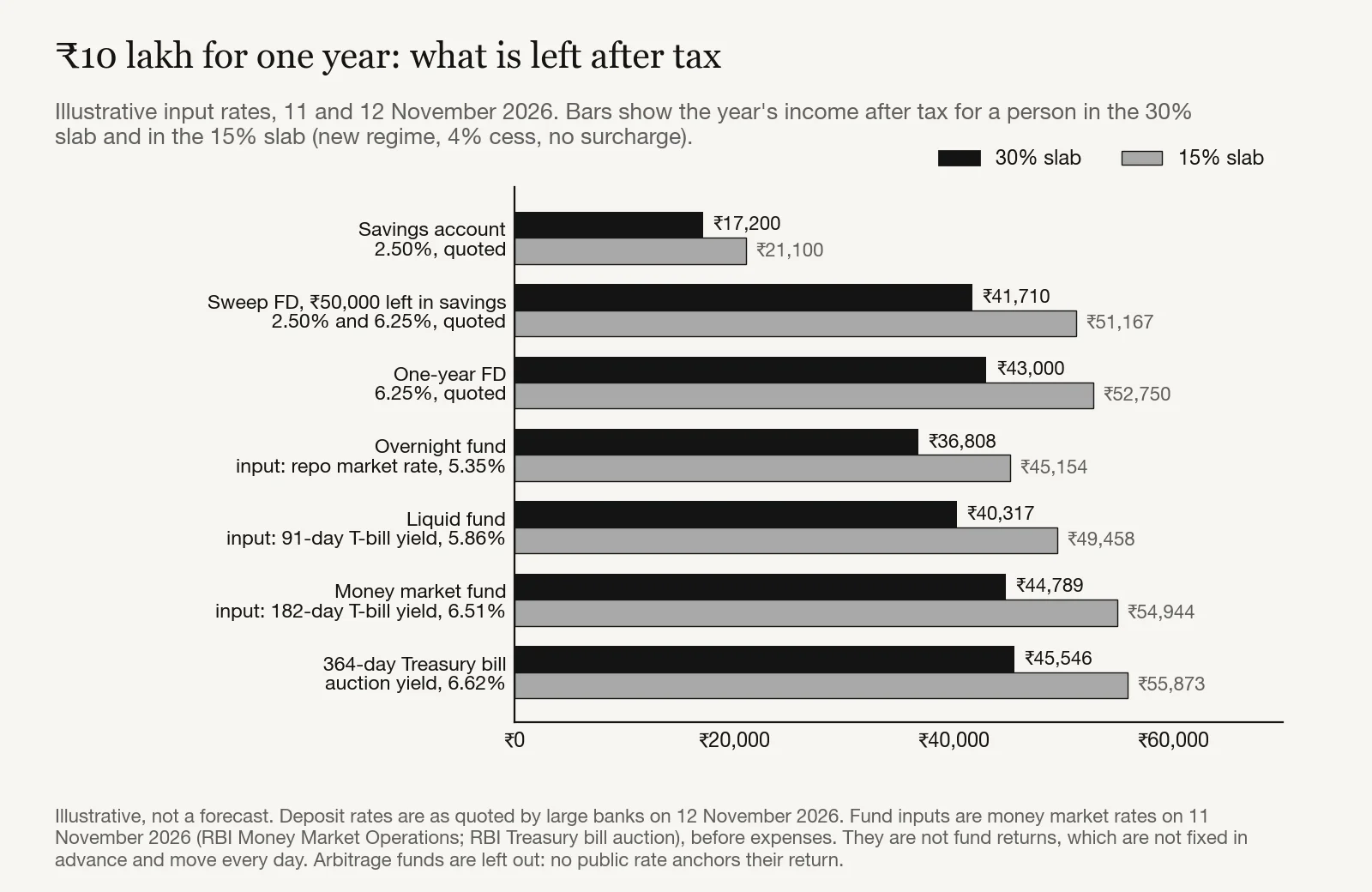
The second pair of columns uses the 15% slab. Just above ₹12 lakh of total income marginal relief applies and each extra rupee goes in tax, so the 15% rate holds from about ₹12.71 lakh to ₹16 lakh. The 5% and 10% slabs are skipped because a person in them has total income of ₹12 lakh or less and, after the rebate, pays no tax on interest or debt fund gains. For that person every row leaves the full income.
Arbitrage funds work differently. Gains on units sold within 12 months are taxed at 20% (20.8% with cess) whatever the slab, and the rebate does not reduce it. After 12 months, gains up to ₹1.25 lakh a year are exempt if no other equity gains have used the limit.
So at these inputs the gap between the savings account and any other row is about ₹19,600 to ₹28,300 a year after tax at the 30% slab. The gaps among the other rows are a few thousand rupees, small enough that speed and protection can decide between them.
How fast the money comes out, and what leaving early costs
Only the savings account and the sweep deposit pay out at any hour. Everything else has a cut-off time or a price for leaving.
Fixed deposits. RBI's directions require banks to allow premature withdrawal on term deposits of ₹1 crore and below held by individuals. The bank pays the rate that applied to the period the money actually stayed, and may deduct a penalty only if it was disclosed when the deposit was opened; one large bank's is 1 percentage point. A two-year deposit booked at 6.50% and closed after a year, where the one-year rate on the booking date was 6.25% and the penalty is 1 percentage point, earns 5.25%: ₹52,500 on ₹10 lakh, against ₹62,500 on a one-year deposit held to maturity. No interest is paid on a deposit closed within seven days.
Overnight and liquid funds. A redemption request placed by 3 pm on a business day is processed that day and normally paid on the next working day; SEBI's outer limit is three working days. Online requests in overnight funds are accepted until 7 pm. On a Friday, a liquid fund request placed after 3 pm is normally paid on Tuesday. Where the fund house offers instant access, a resident individual can take out up to ₹50,000 or 90% of the folio's value, whichever is lower, per day per scheme, credited the same day. SEBI allows this only in overnight and liquid schemes, and the fund house may suspend it.
Liquid funds charge a graded exit load on money withdrawn within six days of going in: 0.0070% on day one, falling by 0.0005 percentage points a day to 0.0045% on day six, and nothing from day seven. On ₹10 lakh that is ₹70 on day one.
Other debt funds and arbitrage funds. The cut-off is 3 pm and the payment limit is three working days. Arbitrage schemes commonly charge 0.25% on units redeemed within 15 or 30 days.
Treasury bills. The face value reaches the linked bank account at maturity. Before that, the bill can be sold on Retail Direct's secondary market at whatever a buyer bids, settled typically on the next working day. If yields have risen since the auction, that price is below the bill's steady accrual.
What protects the money
Bank deposits are insured by DICGC, the RBI's deposit insurance subsidiary, up to ₹5 lakh per depositor per bank, principal and interest together. Funds and Treasury bills are outside that insurance.
The ₹5 lakh covers savings, fixed, recurring and current deposits added together, across all branches of one bank, held in the same capacity and the same right. Deposits in a different bank are counted separately, and so are joint accounts in which the names appear in a different order. So ₹10 lakh in one bank, in one name, is insured for half. Where the RBI places a bank under all-inclusive directions, DICGC has to pay within 90 days.
A fund unit is a share of a portfolio valued at market prices every day. Liquid funds must keep at least 20% of net assets in cash, government securities, Treasury bills and repo on government securities; the rest is paper issued by banks and companies, and a default or a jump in yields shows up in the NAV.
How big an emergency fund is, and what changes the number
We know of no RBI or SEBI rule on the size of an emergency fund. The convention is three to six months of household expenses. The National Institute of Securities Markets, set up by SEBI, reports it as what most financial advisers suggest, and adds that after the pandemic some revised it to six to twelve months. The same page names safety and liquidity as the aims, and a bank account and liquid mutual funds among the places people use.
The months are months of expenses that cannot be put off, EMIs included. What moves the number:
- How many incomes the household has. With one salary, a job loss takes income to zero.
- Dependants and EMIs. Both raise the monthly figure that has to be met.
- Whose health cover it is. An employer's group policy ends with the job, and a hospital bill then comes out of the same fund.
- Notice period and severance terms. A three-month notice period paid out is three months of runway.
- How long a comparable job takes to find in your field.
- Lump sums already known, such as school fees or an insurance premium due in the next few months.
People often split the fund: a month or so of expenses where it can be reached at any hour, the rest in a deposit or fund that pays out a day later. Whether money beyond the fund goes towards prepaying a loan or into investments has its own arithmetic.
FD or debt fund for money needed in two years
At the same pre-tax return, a two-year FD and a debt fund end with the same tax for a person whose slab does not change. They differ in how certain the return is and in what an early exit costs.
On ₹10 lakh at an illustrative 6.50% for two years, compounded yearly, both earn ₹1,34,225. At the 30% slab with cess the tax is ₹41,878 either way: the FD holder pays ₹20,280 after the first year and ₹21,598 after the second, and the fund holder pays the whole amount after redeeming. The first year's tax, kept for one more year, is worth about ₹900 on these numbers.
So the tax alone does not separate them much, unless the redemption falls in a year when your slab is lower. The break-even is simple: the fund has to return, after expenses, what the FD contracts to pay, and nobody can know on the day of investing whether it will.
Laid off with six months of expenses saved: the facts behind SIPs versus cash
Stopping a SIP costs nothing and a new one can be registered later, so the decision is about how many months the cash has to last. A household spending ₹1 lakh a month with ₹6 lakh in hand has six months. If SIPs of ₹30,000 a month continue from the same money it has about 4.6 months, with the SIP money in fund units whose value can rise or fall.

The rules that bear on it:
- Stopping and pausing a SIP. Fund houses charge no penalty for cancelling a SIP, and units already bought stay invested. Since 1 December 2024 a cancellation request has to be processed within two working days. SIPs left to bounce are cancelled after three failed monthly debits in a row (AMFI's uniform process since April 2024), and the bank may charge for each failed debit. The guide on a lagging fund covers pausing.
- Provident fund. The Employees' Provident Funds Scheme, 2026, in force since 1 July 2026, allows the full balance to be withdrawn on retrenchment, a term the labour codes define (paragraph 49). In any other exit the full balance waits for 12 continuous months without covered employment. The 1952 scheme asked for two. Until then paragraph 46 allows partial withdrawals, in "special circumstances" up to twice in a financial year, that leave a minimum balance of 25% of the contributions and interest. It states no waiting period after the job ends. Withdrawals are not taxed after five years of continuous service, or earlier if the service ended for a cause beyond the employee's control (Schedule XI).
- Money from the employer. Compensation on termination is taxed as salary, as "profits in lieu of salary" (section 18), with relief under section 157 where it applies. Section 19 allows a deduction for gratuity, and for leave encashment at retirement from a non-government job, within a formula and a notified limit. The limits notified under the old Act, ₹20 lakh and ₹25 lakh, continue under section 536.
- Health cover. Under IRDAI's master circular of 29 May 2024, a member of a group policy who migrates to an individual policy with the same insurer carries over the waiting-period credit earned. The insurer's terms and timelines apply.
- Tax in a low-income year. If total income for the year, taxable severance included, is ₹12 lakh or less under the new regime, the rebate removes the tax on slab-rate income, gains on debt fund units redeemed that year included. Equity gains do not get the rebate, though a resident can set them against any unused part of the ₹4 lakh basic exemption.
None of this says which way to go. Each month of SIPs continued shortens the runway by the SIP amount divided by monthly expenses, and units sold later to meet expenses fetch whatever the market offers then.
How much of a salary people save: the rule of thumb
No law or regulator sets a savings rate. The figure usually quoted, 20% of take-home pay, comes from the 50/30/20 rule in "All Your Worth", a 2005 American book by Elizabeth Warren and Amelia Warren Tyagi: half of after-tax income for needs, 30% for wants, 20% for savings and debt repayment. For a salaried person in India the 12% of wages that goes to the provident fund, with the employer's matching share, is saving that sits outside the take-home figure. A tracking sheet shows what the household's rate has actually been.
Frequently asked questions
I have ₹10 lakh sitting in my savings account. Where can I park it?
The usual places are a sweep or ordinary fixed deposit, a liquid or money market fund, an arbitrage fund, or Treasury bills through RBI Retail Direct. In November 2026 a large-bank savings account pays 2.5%, a one-year FD 6.25%, and money market rates on 11 November ran from 5.35% to 6.62%. Deposits are insured up to ₹5 lakh per bank; fund returns are market-linked and not fixed in advance.
How big does an emergency fund need to be in India?
No regulator sets a number. The convention, reported by the National Institute of Securities Markets (set up by SEBI), is three to six months of household expenses including EMIs; some advisers moved to six to twelve months after the pandemic. A single income, dependants, employer-only health cover and a short notice period all push it up. The same source names a bank account and liquid mutual funds among the places people keep it.
FD or debt mutual fund for money I need in 2 years?
At the same pre-tax return both are taxed at your slab rate and end with the same tax. The FD's rate is contracted (6.40% and 6.50% for two years at two large banks in November 2026), its interest is usually taxed every year, and it is insured up to ₹5 lakh per bank. The fund's return is not known in advance, its NAV can dip when rates rise, and it is taxed only on redemption.
Laid off with 6 months of expenses saved: do I keep my SIPs or build cash first?
No rule decides it. Cancelling a SIP carries no penalty and a new one can be started later. If a ₹30,000 SIP continues against ₹1 lakh of monthly expenses, a six-month reserve lasts about 4.6 months. Under the 2026 provident fund scheme the full balance opens up on retrenchment, or otherwise after 12 months out of covered work, with 25% held back until then.
How are liquid funds and FDs taxed in 2026-27?
FD interest is taxed at slab rate, usually each year as it accrues, with 10% TDS once interest from a bank passes ₹50,000 in the year. Gains on liquid and other debt funds bought since 1 April 2023 are taxed at slab rate, only when units are redeemed, with no TDS for residents. Under the new regime a resident with total income up to ₹12 lakh pays no tax on either after the section 156 rebate.
How much of my salary do people usually save and invest?
There is no official figure. The common rule of thumb is 20% of take-home pay, from the 50/30/20 rule in a 2005 American book, "All Your Worth". For an Indian employee the provident fund contribution is saving that happens before take-home pay is counted.
Related guides
- Prepay a loan or keep investing: home, education and car loans after tax
- Old or new tax regime for a salaried person in 2026-27
- Harvesting long-term gains before 31 March, lot by lot
- Tracking every investment in one place: what each statement covers
- What a portfolio health check should cover, and why XIRR alone misleads
- Term and health insurance: how much cover, and what a spouse needs to claim
Sources: RBI Monetary Policy Statement, 7 October 2026 (Press Release 2026-2027/1264) and RBI's resolution of 5 December 2025; RBI Money Market Operations as on 11 November 2026; RBI Treasury Bills: Full Auction Result, 11 November 2026 (Press Release 2026-2027/1478); Reserve Bank of India (Commercial Banks - Interest Rate on Deposits) Directions, 2025, updated to 1 October 2026, paragraphs 9 to 11, 22 and 23; RBI Retail Direct Scheme FAQs and RBI's FAQs on government securities; deposit rate pages of two large banks read on 12 November 2026; DICGC, A Guide to Deposit Insurance; Income-tax Act, 2025 (No. 30 of 2025), in force from 1 April 2026: sections 18, 19, 76, 108, 111, 153, 156, 157, 196, 198, 202, 393(1) Table Sl. No. 5, 393(4) Table Sl. No. 6 and 7, 536 and Schedule XI Part A; Finance Act, 2026 (No. 4 of 2026), including the 10% rate in Part II of its First Schedule; CBDT notifications of 8 March 2019 (gratuity limit) and No. 31/2023 (leave encashment limit), as reported; SEBI Master Circular for Mutual Funds, 20 March 2026: scheme categories for debt and hybrid schemes, paras 5.6.1, 5.6.5, 9.4.3, 13.2.1, 15.3 and 15.11; the graded exit load slabs approved by SEBI on 15 October 2019 and circulated by AMFI, as published by fund houses and the press; AMFI guidance on SIP auto-cancellation (April 2024) and the two-working-day SIP cancellation timeline (December 2024), as published by fund houses and the press; Employees' Provident Funds Scheme, 2026 (G.S.R. 525(E) dated 29 June 2026, Gazette of India, 1 July 2026), paragraphs 46 and 49; IRDAI Master Circular on Health Insurance Business, 29 May 2024, clause 11; National Institute of Securities Markets, "Save for Emergencies"; Elizabeth Warren and Amelia Warren Tyagi, All Your Worth (2005). Corpus has applied to SEBI for registration as an investment adviser. This page explains how the rules and statements work and does not recommend any scheme. Investment in securities market are subject to market risks. Read all the related documents carefully before investing.
This is the lead-generation form
Get info from your blog visitors for lead funnel
Corpus
Guides on reviewing a mutual fund portfolio in India: reading your CAS, overlap, commission, what advice costs and who may legally give it. Written by the Corpus team.
Visit Site