Gold in your portfolio: how the share is usually framed, and what a gold ETF, a gold fund, Sovereign Gold Bonds, digital gold and jewellery each cost and how each is taxed in 2026
The ranges used for gold in a portfolio, and the cost and tax of ETFs, gold funds, SGBs, digital gold and jewellery...

Contents
No rule or regulator sets a share of a portfolio for gold. The figures that exist in public documents were written for narrower purposes: SEBI's multi asset allocation fund category needs at least 10% in each of three asset classes, an NPS equity scheme can hold gold and silver ETFs only inside a 5% bucket, and the World Gold Council's India research tests allocations of 7.5% to 15%. On a ₹50 lakh portfolio, 5%, 10% and 15% are ₹2.5 lakh, ₹5 lakh and ₹7.5 lakh.
The form the gold is held in changes what it costs. At a flat gold price, ₹5 lakh held for five years comes back as ₹4,85,189 from a gold ETF, ₹4,70,874 from digital gold and ₹4,57,159 from a coin, on the assumptions set out below. Tax differs too: a listed gold ETF turns long-term after 12 months, a gold fund of funds and physical or digital gold after 24, and since 1 April 2026 a Sovereign Gold Bond is redeemed without capital gains tax only by the person who bought it at issue and held it to maturity.
This guide lays out those rules and that arithmetic as they stand in November 2026. It does not say how much gold to hold or which form to pick. Corpus has applied to SEBI for registration as an investment adviser. This guide explains how the rules and the arithmetic work; it does not recommend any scheme.
What gold did in rupees, as dated facts
The rupee price of gold has had long flat stretches and sharp rises, and neither pattern says what comes next. The Reserve Bank of India's Handbook of Statistics gives the average Mumbai price of gold for each financial year, and the average of the Nifty 50's daily closes (a price index, so dividends are not counted).
Across the six years from 2012-13 to 2018-19 the average gold price rose 3.4% in all, and in 2015-16 it stood at ₹26,534, 12% below its level three years earlier. The Nifty 50's average nearly doubled over those six years. Then the order reversed: from 2018-19 to 2025-26 gold's average multiplied 3.8 times and the Nifty's 2.3 times.
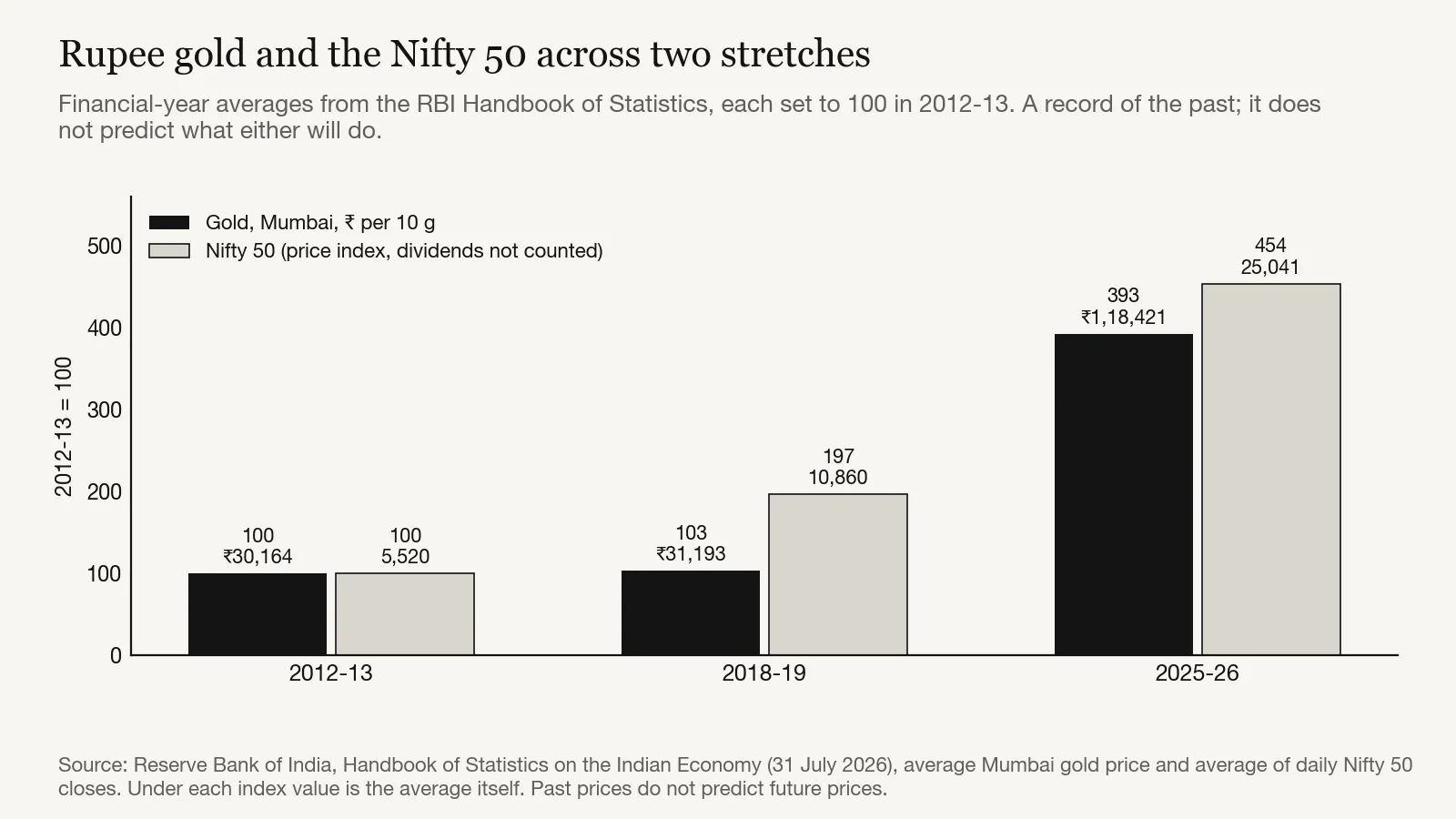
That is the past. It does not predict what gold or shares will do, and other start and end years give a different picture.
The rupee and import duty inside the Indian price
An Indian buyer pays the dollar price of gold, converted at the day's exchange rate, plus import duty. The same Handbook shows the London price falling 23.6% between 2012-13 and 2018-19 ($1,653.51 an ounce to $1,263.16) while the Mumbai rupee price rose 3.4%. A weaker rupee and higher duty made up the difference.
Duty has moved twice in two years. The July 2024 Budget cut the total customs duty on gold from 15% to 6% (basic customs duty of 5% plus an agriculture cess of 1%). Notifications 15/2026-Customs and 16/2026-Customs of 12 May 2026 reversed that, taking the basic duty back to 10% and the cess to 5%, so the total has been 15% since 13 May 2026. We found no later change up to 26 November 2026.
Every form of gold in this guide is priced off the domestic price, so a duty cut lowers the value of gold already held and a duty rise lifts it.
How much: the ranges that exist in rules and public documents
We know of no rule that tells an individual what share to hold in gold. Four published numbers come close, and each was written for something else.
- SEBI's multi asset allocation category. A fund in this category invests in at least three asset classes with at least 10% in each (Master Circular for Mutual Funds, paragraph 3.8.3). Gold is commonly one of the three, though the rule does not name it.
- SEBI's life cycle funds. The glide path tables in Annexure 1B of the same circular give gold and silver ETFs, exchange traded commodity derivatives and InvITs a combined band of 0% to 10% at every stage.
- NPS. PFRDA's master circular of 10 December 2025 for non-government subscribers lets Scheme E (the equity scheme) buy gold and silver ETFs, but those ETFs, REIT units and equity-oriented AIFs together cannot exceed 5% of the scheme's assets. A subscriber cannot choose gold directly.
- The World Gold Council. Its India paper of 17 March 2026 states that from the end of 2006 to the end of 2025 a hypothetical rupee portfolio of shares and bonds had higher risk-adjusted returns and lower drawdowns with 7.5% to 15% in gold. That is the view of a body whose members are gold mining companies, and the paper itself calls the results hypothetical.
How much suits one person depends on their goals and what else they hold, and that is a recommendation only a SEBI-registered investment adviser can make.
What 5%, 10% and 15% mean on ₹50 lakh, and what rebalancing costs in tax
A share is a rupee amount on the day it is set, and it drifts as prices move. The table shows the starting amount, its weight at ₹14,614 a gram (the RBI's Sovereign Gold Bond redemption price for 19 October 2026), and what selling back to the share involves if gold rises 40% while everything else stands still. The 40% is an assumption picked to show the mechanics.
Only the gain inside the units sold is taxed, and for fund and demat units the first bought are treated as the first sold. Gold gets no ₹1.25 lakh exemption. That allowance, covered in harvesting long-term gains before 31 March, belongs to equity. A share can also be restored without a sale, by sending new money to whichever asset has fallen behind, which triggers no tax. If gold falls, restoring the share means buying gold.
Gold ETFs
A gold ETF is a mutual fund scheme whose units trade on the stock exchange and are backed by physical gold. SEBI's master circular (paragraph 4.2) sets the terms:
- Backing. At least 95% of net assets sit in gold and gold-related instruments. The physical gold is standard bars of 995 fineness meeting London Bullion Market Association Good Delivery standards, and the scheme's statutory auditors verify it physically every half year.
- Valuation. Under SEBI's circular of 26 February 2026, the gold is valued at the polled spot prices that recognised stock exchanges publish for settling physically delivered gold contracts. That is a domestic price, with import duty inside it.
- Cost. The base expense ratio of an ETF is capped at 0.90% of daily net assets under the SEBI (Mutual Funds) Regulations, 2026; brokerage and statutory levies are extra. Each scheme's actual ratio is published daily on AMFI's website.
- Tracking. Tracking error may not exceed 2% and is disclosed daily. The measure is explained in the guide to index funds and active funds.
Buying needs a demat account and a broker, so brokerage and the gap between the buying and selling quotes are part of the cost. The exchange shows an indicative NAV (iNAV) during trading hours, based on the latest available gold price, and a unit can trade above or below it.
Gold funds of funds
A gold fund of funds is an ordinary mutual fund scheme that holds units of a gold ETF. It needs no demat account and takes a SIP like any other fund.
The price of that convenience is a second layer of cost: the investor bears the fund of funds' own expenses and, inside its NAV, the ETF's. Regulation 66(7) of the SEBI (Mutual Funds) Regulations, 2026 caps the expense ratio of a fund of funds investing in ETFs at 0.90% of daily net assets, including the weighted average expense ratio of the ETF beneath it. A regular plan also carries the distributor's commission. The fund values its holding at the ETF's closing price on the exchange (paragraph 10.10), so a premium or discount in the ETF passes into its NAV.
Fresh money is not always accepted. One fund house's addendum of 15 October 2026 suspended lump sums and new SIP registrations in its gold fund of funds from the next day "till further notice", while existing SIP instalments and redemptions carried on. Whether a fund is open on a given day is in its latest addendum.
Sovereign Gold Bonds
No Sovereign Gold Bond has been issued since February 2024 (the last tranche was 2023-24 Series IV), and we found no announcement of a new one up to 26 November 2026. The only way in today is to buy an old series on the exchange.
The terms of the bonds in issue, from the RBI's scheme documents:
- Value. Each unit is one gram. On redemption the holder is paid the average closing price of 999 gold over the three business days before.
- Interest. 2.5% a year on the issue price, paid half-yearly. It is taxed at the holder's slab rate, with no tax deducted at source (section 393).
- Tenor. Eight years, with premature redemption allowed after the fifth year on interest payment dates. The RBI's calendar of 21 August 2026 lists the tranches eligible between October 2026 and March 2027 and the window for each request.
The Finance Act, 2026 rewrote the capital gains exemption. Section 70(1)(x) of the Income-tax Act, 2025 now excludes from capital gains a redemption of a Sovereign Gold Bond only "if held by an individual from the date of original issue till maturity", from 1 April 2026. Two groups fall outside those words:
- Buyers on the exchange. A bond bought in the secondary market was not held from original issue, so its redemption at maturity is taxable. The bond is a listed security, so the gain is long-term after 12 months and taxed at 12.5%.
- Original subscribers who redeem early. A premature redemption after the fifth year is not a holding till maturity. The Income Tax Department's Budget FAQs, as quoted in a note on the National Institute of Securities Markets' website, say it is not eligible.
A sale on the exchange was always taxable and still is.
Liquidity is the other cost. Bonds trade only in demat form, each series separately, and volumes can be thin. The traded price is whatever buyer and seller agree, so it can sit above or below the value of the gold.
Electronic Gold Receipts
An Electronic Gold Receipt (EGR) is a demat security that stands for physical gold lying with a SEBI-registered vault manager. It trades on a stock exchange and can be converted back into the metal. SEBI's press release of 8 November 2025 names EGRs with gold ETFs among the gold products it regulates.
Converting gold into an EGR, or back, is not a transfer (section 70(1)(y)), and the time the gold was held counts towards the receipt's holding period. A sale of the receipt is taxed as a capital gain. On the wording of section 2(101) a listed security is long-term after 12 months; we know of no CBDT circular applying that to EGRs.
Digital gold sold by apps
Digital gold is gold bought in small amounts through an app, with the seller holding the metal in a vault on the buyer's behalf. No financial regulator supervises it.
SEBI said so in its press release of 8 November 2025 (PR No. 70/2025): digital gold products "are neither notified as securities nor regulated as commodity derivatives", they "operate entirely outside the purview of SEBI", they may expose investors to counterparty and operational risks, and none of the investor protection mechanisms of the securities market apply to them.
The costs are these:
- GST. 3% on every purchase, as for physical gold. It is not returned on sale.
- Spread. The seller quotes one price to buy and a lower one to sell on the same day. The seller sets the gap. No rule we know of caps it.
- Storage. Sellers' terms set a period of storage without charge (two to ten years in the terms we saw quoted), after which storage fees, delivery or a sale can apply.
- Delivery. Taking coins or bars adds a minting and delivery charge.
For tax, digital gold is treated like physical gold.
Coins, bars and jewellery
Physical gold carries GST at 3% on purchase, added to a price that already includes 15% customs duty.
Jewellery. GST is 3% on the whole invoice value, making charge included; the tax department's sector FAQ says so whether or not the making charge is shown separately. The 5% rate applies to job work, where a customer hands over their own gold to be made up. On resale, neither the making charge nor the GST comes back.
Hallmarking. In the districts covered by the hallmarking order, gold jewellery is sold with a BIS hallmark: the BIS logo, the purity and a six-character alphanumeric HUID. BIS's brief on the scheme (1 October 2026) lists seven grades that can be hallmarked, from 9 to 24 carat, and the hallmarking fee rose from ₹45 to ₹75 an article in September 2026.
Resale. We know of no rule that fixes what a jeweller pays for old gold. Buy-back prices are usually the day's rate for the tested purity less a deduction, and stones are not paid for as gold. Storage adds a locker's rent or the risk of keeping it at home.
Multi asset funds as an indirect route
A multi asset allocation fund that counts gold as one of its three asset classes holds at least 10% in it, usually through gold ETFs or exchange traded derivatives. The fund manager moves the share within the scheme's stated bands, so the investor does not control it. Gold held this way does not appear as gold on a statement; finding it takes the fund's monthly portfolio disclosure, the same look-through used for overlap between funds. The fund is taxed as a fund: its own equity and debt mix decides the holding period and rate.
How each form is taxed in 2026-27
Except on an SGB held from issue to maturity, a gain is a capital gain: 12.5% with no indexation if long-term (section 197), the holder's slab rate if short-term. What differs is how long the asset must be held to be long-term (section 2(101)).
Rates are before surcharge and the 4% cess. A resident whose other income is below the basic exemption limit can set the unused part against long-term gains (section 197(2)).
Units bought between 1 April 2023 and 31 March 2025. Under the 1961 Act as it then stood, gold ETF and gold fund units bought on or after 1 April 2023 were taxed at slab rates however long they were held, because a "specified mutual fund" meant any fund with 35% or less in Indian shares. Section 76 of the 2025 Act carries a narrower definition: a fund with more than 65% in debt and money market instruments, or a fund of funds with 65% or more in such funds. A gold fund is neither, so units bought in that window and sold in 2026-27 follow the table above. The full rate table for every fund type is in the consolidation guide.
A loss on gold held long-term can be set off only against long-term gains, and carried forward if unused (section 111).
₹5 lakh for five years in three forms: a worked example
This illustration holds the gold price flat for five years, so only costs and taxes change the outcome. The buyer pays out ₹5,00,000 in each case. Every rate is an assumption; actual charges vary by scheme and seller.
Two more cases on the same footing. A gold fund of funds at an assumed 0.70% a year for both layers returns ₹4,82,743, a cost of ₹17,257 (3.5%). Jewellery of 22 carat with an assumed 12% making charge, 3% GST and 3% off on resale holds ₹4,33,426 of gold and returns ₹4,20,423, a cost of ₹79,577 (15.9%).

The ETF's costs build up with time and the others are paid mostly at the door: at these assumed rates the ETF's cost would pass digital gold's after roughly eleven years. If the price rises instead, all three are long-term at five years and pay the same 12.5% on the gain. The holding periods separate them only for a sale between 12 and 24 months, when the ETF's gain alone is long-term.
The illustration says nothing about what gold will return.
Gold already in the family, the Gold Monetisation Scheme and loans against gold
Many households already own gold as jewellery. Whether to count it is a choice with no rule behind it. People who count it usually take the gold weight at the day's rate for its purity, leave out making charges and stones, and enter it by hand, since it appears on no statement; tracking every investment in one place covers how. Leaving it out makes the share on paper lower than the household's real exposure to the gold price. When inherited jewellery is sold, the cost for tax is what the previous owner paid or, at the seller's option, the fair market value on 1 April 2001 if the previous owner acquired it before that date.
The Gold Monetisation Scheme is mostly closed. The government discontinued its medium-term and long-term government deposits, renewals included, from 26 March 2025. Short-term bank deposits of one to three years continue at each bank's discretion.
A loan against gold jewellery or coins is capped by the RBI's 2025 Directions at 85% of the gold's value for consumption loans up to ₹2.5 lakh, 80% up to ₹5 lakh and 75% above that. Lenders had to comply by 1 April 2026.
Frequently asked questions
How much of my portfolio do people usually put in gold, and through an ETF or a fund?
No rule fixes a share. The published reference points include SEBI's multi asset allocation category (at least 10% in each of three asset classes), the 5% cap on gold and silver ETFs, REITs and AIFs together inside an NPS equity scheme, and the World Gold Council's back-tested range of 7.5% to 15%. On ₹50 lakh, 5%, 10% and 15% are ₹2.5 lakh, ₹5 lakh and ₹7.5 lakh. An ETF needs a demat account and turns long-term after 12 months; a gold fund of funds takes a SIP without demat, adds its own expenses to the ETF's and turns long-term after 24 months. Which share and route suit you is a recommendation for a SEBI-registered adviser.
Gold ETF vs digital gold vs physical gold: which one is right for me?
Side by side: a gold ETF is regulated by SEBI, backed by audited bars of 995 fineness, has a base expense ratio capped at 0.90% a year with brokerage and levies extra, and is long-term after 12 months. Digital gold is outside SEBI's purview (press release of 8 November 2025), carries 3% GST and a seller-set spread, and is long-term after 24 months. Coins and jewellery carry 3% GST on the full invoice, making charges and a resale deduction, and are long-term after 24 months. Long-term gains on each are taxed at 12.5%. On this guide's assumptions, ₹5 lakh held five years at a flat price returns ₹4,85,189, ₹4,70,874 and ₹4,57,159 respectively. Which is right depends on whether you want to wear the gold or only hold its price, and this guide does not choose.
Are Sovereign Gold Bonds still tax-exempt at maturity, and can I still buy them?
The exemption now covers only an individual who bought the bond at original issue and held it to maturity: the Finance Act, 2026 rewrote section 70(1)(x) of the Income-tax Act, 2025 from 1 April 2026. A bond bought on the stock exchange, or redeemed early after the fifth year, gives a taxable gain: 12.5% if held more than 12 months, slab rate otherwise. No new tranche has been issued since February 2024, so buying today means buying an old series on the exchange.
Is digital gold regulated by SEBI?
No. SEBI's press release of 8 November 2025 says digital gold products are neither securities nor commodity derivatives, operate entirely outside its purview, may carry counterparty and operational risks, and get none of the securities market's investor protection mechanisms. It names gold ETFs, exchange traded gold derivatives and Electronic Gold Receipts as the gold products it does regulate.
How is a gold ETF or gold mutual fund taxed in 2026-27?
A listed gold ETF is long-term after 12 months and a gold fund of funds after 24. Long-term gains are taxed at 12.5% without indexation and with no ₹1.25 lakh exemption; short-term gains are taxed at your slab rate. Units bought between 1 April 2023 and 31 March 2025 follow the same rule when sold now, because section 76 of the 2025 Act treats only debt-heavy funds as specified mutual funds.
What does it cost in tax to rebalance gold back to 10% of my portfolio?
Only the gain inside the units sold is taxed. On ₹50 lakh with ₹5 lakh in gold, an assumed 40% rise in gold with everything else unchanged lifts the share to 13.5%; selling ₹1,80,000 restores 10%, the gain in that sale is ₹51,429, and the tax is ₹6,686 if long-term or ₹16,046 at a 30% slab if short-term. Directing new money to the other assets involves no sale and no tax.
Related guides
- Mutual fund overlap across your whole portfolio
- Harvesting long-term gains before 31 March, lot by lot
- Idle cash and the emergency fund: where to keep it, after tax
- Tracking every investment in one place: what each statement covers
- Consolidating 17 mutual funds into 5: exit loads, capital gains and the order of operations
- What a portfolio health check should cover, and why XIRR alone misleads
Sources: Reserve Bank of India, Handbook of Statistics on the Indian Economy, 31 July 2026 (average price of gold in Mumbai and London; averages of the Nifty 50); Notifications 15/2026-Customs and 16/2026-Customs of 12 May 2026, Notification 45/2025-Customs of 24 October 2025 and the Union Budget of 23 July 2024; World Gold Council, "Why gold in 2026? An anchor for Indian portfolios", 17 March 2026; SEBI Master Circular for Mutual Funds, 20 March 2026, paragraphs 3.8.3, 4.2, 4.5.4, 4.5.9, 10.9 and 10.10 and Annexure 1B; SEBI (Mutual Funds) Regulations, 2026 (last amended 10 October 2026), regulation 66(7); a fund house addendum of 15 October 2026 on a gold fund of funds; PFRDA Master Circular PFRDA/Master Circular/2025/06/PF-04 of 10 December 2025; SEBI press release PR No. 70/2025 of 8 November 2025, Caution to public regarding dealing in 'Digital Gold'; Income-tax Act, 2025 as amended by the Finance Act, 2026 (section 43 of that Act): sections 2(101), 70(1)(x) and (y), 73, 76, 111, 197 and 393; RBI FAQs on the Sovereign Gold Bond Scheme and RBI press releases of 21 August 2026 (premature redemption calendar) and 16 October 2026 (redemption price of ₹14,614); a note on the National Institute of Securities Markets website on Sovereign Gold Bond taxation after Budget 2026; Central Board of Excise and Customs, GST sectoral FAQs on gems and jewellery; Bureau of Indian Standards, Brief on Hallmarking Scheme (updated 1 October 2026) and BIS (Hallmarking) Amendment Regulations, 2026; RBI FAQs on the Gold Monetisation Scheme, 2015 (updated 25 March 2025); Reserve Bank of India (Lending Against Gold and Silver Collateral) Directions, 2025. Figures in the worked examples are illustrative; cost rates and price changes are assumptions, past prices do not predict future prices, and market returns are not promised. Corpus has applied to SEBI for registration as an investment adviser. This page explains how the rules and the arithmetic work and does not recommend any scheme. Investment in securities market are subject to market risks. Read all the related documents carefully before investing.
This is the lead-generation form
Get info from your blog visitors for lead funnel
Corpus
Guides on reviewing a mutual fund portfolio in India: reading your CAS, overlap, commission, what advice costs and who may legally give it. Written by the Corpus team.
Visit Site