Credit cards and your CIBIL score in India: getting a first card without a salary slip, what moves the score, what the minimum due costs, getting out of card debt, and the annual-fee arithmetic for picking or upgrading a card
How a CIBIL score is built, a first card without a salary slip, closing a card, the cost of the minimum due, and the annual-fee arithmetic...

Contents
A credit score in India is a number from 300 to 900 that each of the four credit information companies works out from what lenders report about you; "CIBIL score" is the name people use for all of them. Payments made on time and a small share of your limits in use push it up. Missed dues and a run of applications pull it down. Since 1 July 2026 banks and NBFCs have reported as on the 9th, the 16th, the 23rd and the last day of every month. So on these timelines a payment reaches your report within about two weeks.
A card whose bill is paid in full by the due date costs no interest. A balance left revolving costs up to 3.75% a month plus GST in the issuer terms we read in November 2026, and paying only the minimum keeps that rate running on nearly all of it. This guide sets out RBI's card and credit-report rules as they stand, and the arithmetic behind each choice. It names no card, bank or issuer. Corpus has applied to SEBI for registration as an investment adviser. This guide explains how the rules and the card terms work; it does not recommend any scheme.
How a credit score is built, and what moves it
A score is built from what lenders report: each card and loan, its limit, the balance and the payment record. Lenders report to all four credit information companies (CICs) registered with RBI, which are TransUnion CIBIL, Experian, Equifax and CRIF. All four use the 300 to 900 scale RBI prescribes. But each runs its own model, so one person's four scores differ.
None that we found publishes its weights in percentages, but two describe them in words:
So building a score from nothing means an account that gets reported, paid on time every month with little of its limit in use, and held long enough to make a history. Each CIC has to give you one full report with your score, at no charge, once in every calendar year, from a link on its home page.
How often lenders report, and how a wrong entry gets fixed
Since 1 July 2026 banks and NBFCs have reported as on four dates a month: the 9th, the 16th, the 23rd and the last day. The month-end file reaches the CICs by the 5th of the next month. The mid-month files carry only accounts that changed (a repayment or a new balance, for instance) and go within four calendar days, and the CICs then have three calendar days to load them. A card cleared on the 10th is in the file as on the 16th and can be on your report by about the 23rd. Reporting was monthly until December 2024 and fortnightly from January 2025 to June 2026.
Lenders send an SMS or email when they report a default or days past due. A card issuer also has to tell you before it reports a card in default, and must update the CIC within 30 days once the dues are settled. Each time a lender pulls your report, the CIC sends its own alert, where it has your mobile number or email.
Errors get fixed at source. The lender that reported a wrong entry corrects it. Section 21(3) of the Credit Information Companies (Regulation) Act, 2005 and rule 20(3)(c) of the 2006 Rules give the lender 21 days and the whole chain 30 days from your complaint. Past 30 calendar days, RBI's directions entitle you to ₹100 for each day of delay, paid into your bank account within five working days of the fix. A lender that rejects a correction has to give its reason.
Getting a first credit card
A first card comes from an application backed by proof of income or, without one, from a card secured against a fixed deposit. Either way the issuer checks your means and your credit file. RBI's card directions require it to judge credit risk on the applicant's own financial means and to count limits held elsewhere. Applications for unsecured cards ask for proof of income such as salary slips or an income tax return.
An empty file is different. RBI's credit-reporting directions list, among practices banks take into account, that a first-time borrower is not refused just for having no credit history. Issuers still apply their own policies. With no account at all there is nothing to score: CRIF returns "NH" for no history, and Experian gives no score until a first card or loan.
Fixed points in the process:
- Key Fact Statement. A one-page summary of rates and charges comes with the application.
- Refusal in writing. An issuer that turns you down has to give the specific reasons in writing.
- Activation. A card not activated within 30 days needs your OTP consent; without it the issuer closes the account at no cost within seven working days.
- Reporting. Nothing about a new card reaches the CICs until it is activated. Cards nobody asked for are barred, and if one is activated and billed without consent, the issuer reverses the charges and pays twice their amount.
Every application is a hard enquiry. So several in a few weeks show as several.
Without a salary slip or a stable job
The route that needs no income proof is a card secured against a fixed deposit. The bank holds the deposit as collateral, the deposit keeps earning interest, and the card's limit is a share of it. Two banks' pages read in November 2026:
The second bank's page says the card needs no income proof, employment history or credit score. On ₹50,000 in a deposit, a 90% limit is ₹45,000, and the card is reported like any other. Its interest rate depends on the issuer: one charges 2.75% a month on secured cards against 3.75% on unsecured ones, and another charges a deposit-backed card the same rate as its variant.
An add-on card on a family member's account is the other route. The liability rests entirely with the principal cardholder. Whether an add-on builds a history in the add-on holder's own name depends on how the issuer reports it; we found no rule on that.
Does closing a credit card lower your score
It can, through utilisation. The issuer's side is tightly ruled, by the same RBI text for banks and NBFC issuers. It has to close a card within seven working days of your request once dues are paid, take the request through any channel it runs (helpline, email, website or app), and pay you ₹500 for each calendar day of delay beyond that. And it reports the closure to the CICs.
Take two cards with limits of ₹2 lakh and ₹1 lakh and ₹45,000 of spending a month. With both open, that is 15% of ₹3 lakh. Close the ₹2 lakh card and the same spending is 45% of the ₹1 lakh left, above the 40% in Experian's FAQ. Close the ₹1 lakh card instead and it is 22.5%.
Age is murkier. A closed account stays in the CIC's file with its payment record, and CRIF gives no score at all to people whose accounts were all closed more than 36 months ago with nothing taken since. We found no CIC that publishes how its model counts the age of a closed account.
An issuer can also close a card unused for more than a year, after writing and waiting 30 days for a reply. A switch to a variant without a fee at the same issuer is the other option; whether that keeps the same account, and its age, depends on the issuer.
Using a card without carrying debt
A card costs no interest when the total amount due on each statement is paid by the due date. Purchases collect over a billing cycle of about a month. In the terms we read, the due date falls about 20 days after the statement, and RBI requires at least a fortnight between the bill and the start of interest. That gives each purchase a grace period of 20 to 50 days, depending on where in the cycle it falls.
What is paid by the due date decides the rest:
Cash is different. A withdrawal on a card is charged interest from the day it is made in both issuers' terms, plus a fee.
RBI lets you change the billing cycle at least once, to any start or closing date, so the due date can follow salary day. Any spend over the limit needs your explicit consent, which you can switch off.
On utilisation, Experian's FAQ measures it against the limit "at any given point". Lenders report as on each reference date, balance changes included. We found no rule or bureau page saying whether that is a card's running balance or its last statement's.
What paying only the minimum costs
Paying the minimum keeps the account current and the interest running. The minimum is that month's interest and GST plus any fees, and a slice of the balance as well: 1% in one issuer's terms, 2% in another's, and in a third 5% of the balance and interest together. RBI requires it to cover the month's interest and charges, bars interest on unpaid taxes and fees, and requires every statement to warn that paying only the minimum stretches repayment over months or years.
An illustrative ₹1 lakh at 3.75% a month with 18% GST on the interest, and no new spending:
At 1% of the balance it takes about 19 years to get under ₹10,000. At 2%, nine and a half. One issuer's own example says ₹10,000 paid at the minimum takes up to 52 months to clear. Issuers work interest out daily from transaction dates, so the monthly figures here are close approximations.
Getting out of card debt: what each route costs
Card dues at 3.75% a month plus GST cost about 53% a year. Each route out has its own rate and fees.
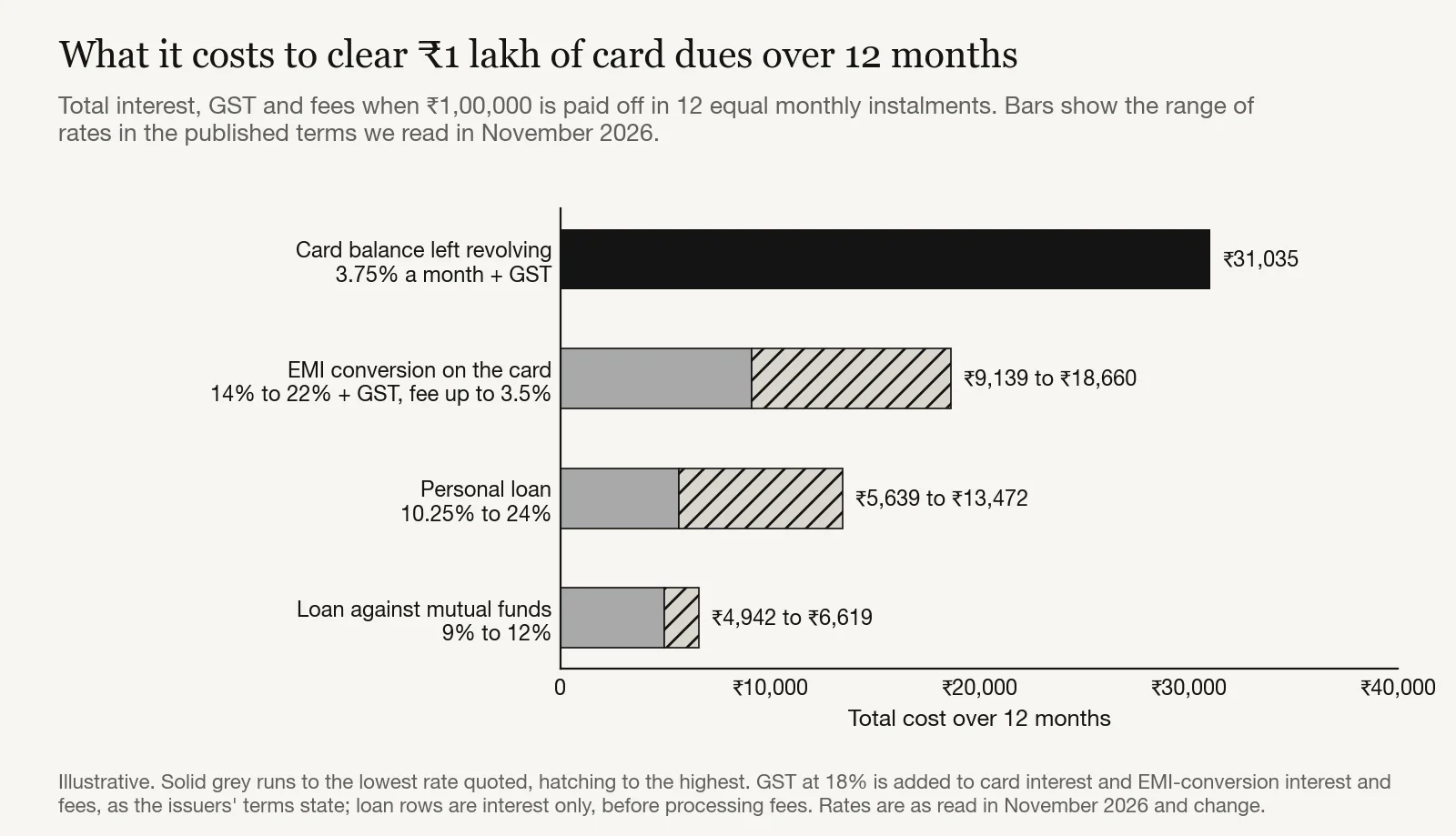
- EMI conversion on the same card. One issuer's undated terms, read on 16 November 2026, quote 14% to 22% a year on the reducing balance, a fee of up to 3.5%, GST on both and 2% to close early; another published 10.08% to 24.96% for July to September 2026. RBI requires the interest and any discount to be shown before conversion and bars calling an interest-bearing plan "no-cost".
- Balance transfer to another card. One issuer offers 0% for 60 days or 1.7% a month for 180 days, and another charges a fee of 1% or ₹250, whichever is higher. In the first issuer's terms, purchases made while the transferred balance is on the card are charged interest from the date of purchase.
- A personal loan. One large private bank publishes 10.25% to 24% a year. It clears the card at once and leaves a fixed EMI, and what prepaying that loan later costs depends on its terms.
- A loan against mutual funds. Lender pages put rates at roughly 9% to 12%. The units stay invested under a lien, banks can lend up to 75% of the value of equity fund units, and a fall in value brings a margin call.
- Redeeming investments. No interest, and a one-time tax that depends on the lot: nil on long-term equity fund gains inside the year's ₹1.25 lakh exemption, 20% plus cess on short-term ones, and any exit load on each lot.
Whichever route is used, new spending on a card that still carries a balance is charged interest from day one. Recovery has limits as well: an issuer and its agents may not intimidate or harass a cardholder or the family.
₹2 lakh in card dues and ₹15 lakh in mutual funds
This is a monthly charge against a one-time cost. At 3.75% a month, ₹2 lakh of revolving dues costs ₹7,500 of interest and ₹1,350 of GST: ₹8,850 a month. The same ₹2 lakh by each route:
Even the short-term redemption costs about one month of the card's charges, once. The loan keeps the units in the market, where nobody can promise returns. The lot-by-lot working is in ₹2 lakh of card dues and ₹15 lakh in mutual funds.
If the dues came from a monthly shortfall, the gap reopens whatever clears them. How big an emergency fund is and where it sits has its own arithmetic.
Picking a main card: the annual fee against your own spend
For anyone who pays in full, the sum is rewards on the spending that qualifies, less the annual fee with 18% GST. Interest never enters it. Nor does the limit. Between two cards, the break-even spend is the difference in fees divided by the difference in reward rates.
Four invented card types, with reward values as assumptions (a point is worth what its redemption gets):
The ₹2,500 card (₹2,950 with GST) passes the card with no fee at ₹2.95 lakh of rewarded spend a year. The ₹10,000 card (₹11,800 with GST) passes it at ₹5.13 lakh, and passes the ₹2,500 card at ₹6.81 lakh. On these assumptions the main card for a given person is the one with the largest figure in their own spend row.

The card terms move the inputs in four ways:
- Fee waivers. One large issuer waives the renewal fee on most cards when last year's spend crosses a threshold, from ₹30,000 on one ₹499 card to ₹15 lakh on one ₹4,999 card.
- Excluded spending. Both issuers we read charge 1% on wallet loads and utility bills above a threshold and on education payments made through third-party apps; one adds ₹199 plus GST to every rent payment.
- Foreign spending. One issuer's markups on foreign-currency transactions run from 1.99% to 3.5%, enough to cancel a reward rate on that spend.
- Interest. One issuer charges 1.99% a month on a handful of cards, its premium ones among them, and 3.75% on nearly all the rest. Paid in full, neither applies.
Upgrading to a different card
An upgrade needs your explicit consent. RBI's directions bar issuers from upgrading a card or raising its limit on their own, and count a higher limit as an upgrade. A card upgraded and billed without consent gets the charges reversed plus twice their amount.
It comes about in one of two ways. The issuer reviews the account and offers a higher variant or limit, which you accept or decline; one issuer's terms also let a cardholder ask for a higher limit by sending income documents. Or you apply for a different card: a new account and a new hard enquiry, while the old card, if kept open, keeps its history and its limit.
Issuers can also move a cardholder down: one large private bank offers another variant, or closes the card after 30 days' notice, when its spend or balance conditions stop being met.
When a card is devalued
A devaluation is a change in the card's terms, which needs 30 days' notice so the holder can withdraw. A change in charges takes effect only from a future date with at least a month's notice, and a cardholder for whom it is a disadvantage can surrender the card without an extra charge for closing it, once dues are paid.
The sum to re-run is the one in the table. It moves a lot. If the ₹10,000 card's rewards are cut from 3.3% to 2%, its break-even against a card with no annual fee goes from ₹5.13 lakh to ₹11.8 lakh of rewarded spend a year. Below that, the card with no fee nets more on these assumptions.
Points expire too. One issuer's last 24 months on most cards, another's one to three years, and the second allows only 30 days after closure to redeem them. We know of no RBI rule on refunding part of an annual fee already billed when a card is closed. So the issuer's terms decide it.
How invite-only and high-fee cards are usually obtained
The premium tiers usually come by invitation. One large private bank's page for its invite-only card says the bank assesses eligibility itself and tells the customer personally. Its terms for keeping the card show what it looks at: since 1 April 2026, ₹18 lakh of card spend in a financial year (add-on cards included) or a relationship value of ₹50 lakh, meaning average monthly balances in savings and current accounts and in fixed and recurring deposits.
So the inputs are ones the issuer sees in its own books: spending on its cards, paid in full, and balances held with it.
Whether a high fee pays back is the same sum. A ₹10,000 fee is ₹11,800 with GST, and against a card with no fee earning 1%, rewards worth 3.3% recover it at ₹5.13 lakh of rewarded spend. Lounge visits and bundled memberships count at what you would otherwise pay for them. The 1.99% monthly finance charge on some of these cards matters only to someone carrying a balance.
Frequently asked questions
How do I build my CIBIL score from scratch?
A score needs an account that lenders report, such as a credit card or a card secured against a fixed deposit, paid in full by every due date. The credit information companies' FAQs give payment history and the share of limits in use the most weight, and Experian suggests using up to 40% of your limit. Each application is a hard enquiry, listed for two years.
I don't have a salary slip or a stable job. How do I get a credit card?
The usual route is a card secured against a fixed deposit. Banks' pages read in November 2026 set the limit at up to 90% of the deposit, with smallest deposits of ₹15,000 and ₹50,000, and one says no income proof or credit score is needed. The card is reported like any other, so it builds a payment record.
Does closing a credit card reduce my CIBIL score?
It can, because the same spending becomes a larger share of the limits left: ₹45,000 a month is 15% of ₹3 lakh of limits and 45% of ₹1 lakh. The issuer has to close the card within seven working days of your request once dues are paid, or pay you ₹500 a day for the delay.
What happens if I pay only the minimum amount due on my credit card?
There is no late fee and no past-due report. The grace period is lost, though: interest at up to 3.75% a month plus GST runs on the unpaid balance from each purchase's date, and on new purchases from their own date, until everything is paid. On ₹1 lakh, a minimum of interest and GST plus 2% of the balance leaves ₹78,472 owed after a year, with ₹47,631 paid in interest and GST.
How do I get out of credit card debt?
Every route replaces the card's 3.75% a month with another rate. Clearing ₹1 lakh over 12 months costs about ₹31,035 on the card at 3.75% a month plus GST, ₹9,139 to ₹18,660 by EMI conversion, ₹5,639 to ₹13,472 with a personal loan at 10.25% to 24%, and ₹4,942 to ₹6,619 with a loan against mutual funds at 9% to 12%.
I have 2 lakh in credit card dues and 15 lakh in mutual funds. What do I do first?
The dues cost ₹8,850 a month at 3.75% plus GST. Redeeming ₹2 lakh of units costs no tax if the gain is long-term and inside the year's ₹1.25 lakh exemption, and ₹8,320 once if the units carry ₹40,000 of short-term gain. A loan against the funds at 9% to 12% costs ₹1,500 to ₹2,000 a month and keeps the units invested, with market risk and a margin call.
My card just got devalued again. Is it worth switching to a card with no annual fee?
The break-even spend is the annual fee with GST divided by the difference in reward rates. A ₹10,000 fee (₹11,800 with GST) on a card whose rewards fall from 3.3% to 2% needs ₹11.8 lakh of rewarded spend a year to match a card with no fee earning 1%, against ₹5.13 lakh before the cut. When a change in charges is to your disadvantage, RBI's rules let you surrender the card without an extra closure charge.
Is an invite-only premium credit card worth the annual fee, and how do you get one?
The issuer offers it after its own assessment. One large private bank's terms tie keeping its invite-only card, since 1 April 2026, to ₹18 lakh of annual card spend or ₹50 lakh of average balances with the bank. The fee pays back when the extra rewards you redeem, plus benefits you would otherwise buy, exceed the fee with GST.
Related guides
- Prepay a loan or keep investing: home, education and car loans after tax
- Idle cash and the emergency fund: where to keep it, after tax
- Old or new tax regime for a salaried person in 2026-27
- Tracking every investment in one place: what each statement covers
- What a portfolio health check should cover, and why XIRR alone misleads
- Who is legally allowed to tell you what to do with your portfolio
Sources: Reserve Bank of India (Commercial Banks - Credit Cards and Debit Cards: Issuance and Conduct) Directions, 2025, RBI/DOR/2025-26/155, 28 November 2025 (updated as on 1 October 2026), which replaced the 2022 Master Direction for commercial banks: paragraphs 5(23), 11(1), 11(4), 11(6), 11(7), 12(1), 12(2), 12(3), 12(5), 18, 19, 20, 23(2), 23(3), 23(5), 23(6), 23(7), 24, 29, 34, 36, 39 and 79; Reserve Bank of India (Non-Banking Financial Companies - Credit Cards: Issuance and Conduct) Directions, 2025, RBI/DOR/2025-26/348, 28 November 2025; Reserve Bank of India (Commercial Banks - Credit Information Reporting) Directions, 2025, RBI/DOR/2025-26/156, 28 November 2025 (updated as on 1 July 2026, after the Amendment Directions of 4 December 2025): paragraphs 10(2), 19, 34, 35 and 38(5), and the corresponding NBFC directions, RBI/DOR/2025-26/349; Reserve Bank of India (Credit Information Companies) Directions, 2025, RBI/DOR/2025-26/378 (updated as on 1 July 2026): paragraphs 4(2), 21(3), 21(7), 37 and 39; RBI circular on reporting of credit information at fortnightly intervals, 8 August 2024; Credit Information Companies (Regulation) Act, 2005, sections 5 and 21(3); Credit Information Companies Rules, 2006, rule 20(3)(c); consumer FAQ pages of Experian Credit Information Company of India and CRIF Credit Information Services; most important terms and conditions and key fact statements of three card issuers (one updated on 11 November 2026), the balance-on-EMI terms of one of them, the EMI rates another published for July to September 2026, and two banks' pages on cards against fixed deposits, all read on 16 November 2026; personal loan and loan-against-mutual-fund rates and bank loan-to-value limits as checked for the guide on prepaying loans on 12 November 2026. Rupee examples are illustrative, use reader-style inputs and invented card types, and are computed at constant rates. Corpus has applied to SEBI for registration as an investment adviser. This page explains how the rules and statements work and does not recommend any scheme. Investment in securities market are subject to market risks. Read all the related documents carefully before investing.
This is the lead-generation form
Get info from your blog visitors for lead funnel
Corpus
Guides on reviewing a mutual fund portfolio in India: reading your CAS, overlap, commission, what advice costs and who may legally give it. Written by the Corpus team.
Visit Site