Consolidating 17 mutual funds into 5: exit loads, capital gains and the order people do it in
You cannot merge two schemes without selling one. Costs per lot, FY 2026-27 tax rates, the usual sequence, and inherited folios...

Contents
At 31 March 2026 Indian mutual funds had 27.39 crore folios and 6.14 crore unique investors, which works out to about four and a half folios per person (SEBI's annual report for 2025-26). An average of four and a half means some investors hold many more. Anyone who started a SIP in their first job, added a fund every time a colleague or an app suggested one, and never stopped the old ones can be sitting on fifteen or twenty schemes by their mid-thirties. An inherited portfolio can add a parent's folios on top.
So getting from there to a handful is mostly a question of sequence. The tax and the exit loads are charged per purchase lot, the ₹1.25 lakh exemption resets every financial year, and the order in which you redeem decides how much of each you pay. This guide sets out those costs and the order they are usually worked through in. It does not say which five to keep. Corpus has applied to SEBI for registration as an investment adviser. This guide explains how the rules and the statements work; it does not recommend any scheme.
Can two funds be merged without selling one?
No. There is no route by which an investor can fold scheme A into scheme B. Even inside one fund house, a switch from one scheme to another is a redemption from the first and a purchase in the second. For tax it is a transfer, so capital gains arise on every lot that leaves, and the first scheme's exit load applies to any lot still inside its load window.
Two kinds of consolidation are tax-neutral, and neither is in your hands. If a fund house merges two of its own schemes (equity into equity, or non-equity into non-equity), the Income-tax Act, 2025 does not treat the exchange of units as a transfer, and your original cost and holding period carry into the surviving scheme. The same applies when a fund house consolidates plans within one scheme. If you hold a scheme that is being merged into another, SEBI's rules treat the merger as a change in its fundamental attributes, so before it happens you get a letter and at least 30 days to exit at NAV with no exit load. Holders of the surviving scheme get that window only if their own scheme's attributes change.
Folio consolidation is a different thing with a similar name. It merges several folios you hold with one fund house into one folio number; it is an administrative request, it changes nothing for tax, and it does not reduce the number of schemes you own. If you request it on MF Central, read the consent text: the IDCW option (payout or reinvestment) of the source folios is converted to the target folio's option, and the request goes through even if bank and nominee details differ between the folios.
What each lot costs to leave
Every purchase and every SIP instalment is a separate lot with its own allotment date, and a redemption takes the oldest lots first. Three things can apply to a lot when it leaves.
Exit load. Charged as a percentage of NAV on units redeemed or switched out within a window measured from each lot's allotment date. SEBI's cap is 3% of NAV (down from 5% since November 2025, and now regulation 44(4) of the 2026 regulations), and the load is credited back to the scheme. One year at 1% is still common on actively managed equity and hybrid schemes. But a lot of fund houses shortened their windows to 30 or 90 days in 2025 and 2026, or dropped the load altogether. Two details matter for an old portfolio. First, scheme documents generally apply to a SIP the load that was in force on the day the SIP was registered, so a 2022 SIP can still have a one-year window after the scheme moved new investors to 30 days. Second, a switch between the regular and direct plans of the same scheme carries no exit load at all (SEBI's master circular of 20 March 2026 says so in terms), though it is still taxed.
Index funds usually charge nil or a small load for a few days, arbitrage funds commonly 0.25% for 15 days, and liquid funds a graded load of a few thousandths of a percent for the first six days. ELSS has no exit load, but each instalment is locked in for three years from its allotment.
Capital gains tax. Depends on the fund type, how long the lot was held and whether there was a gain. The table below has the FY 2026-27 position.
Small transaction costs. STT of 0.001% on redemptions of equity-oriented units, and stamp duty of 0.005% on mutual fund units you buy with the money (a switch-in included).
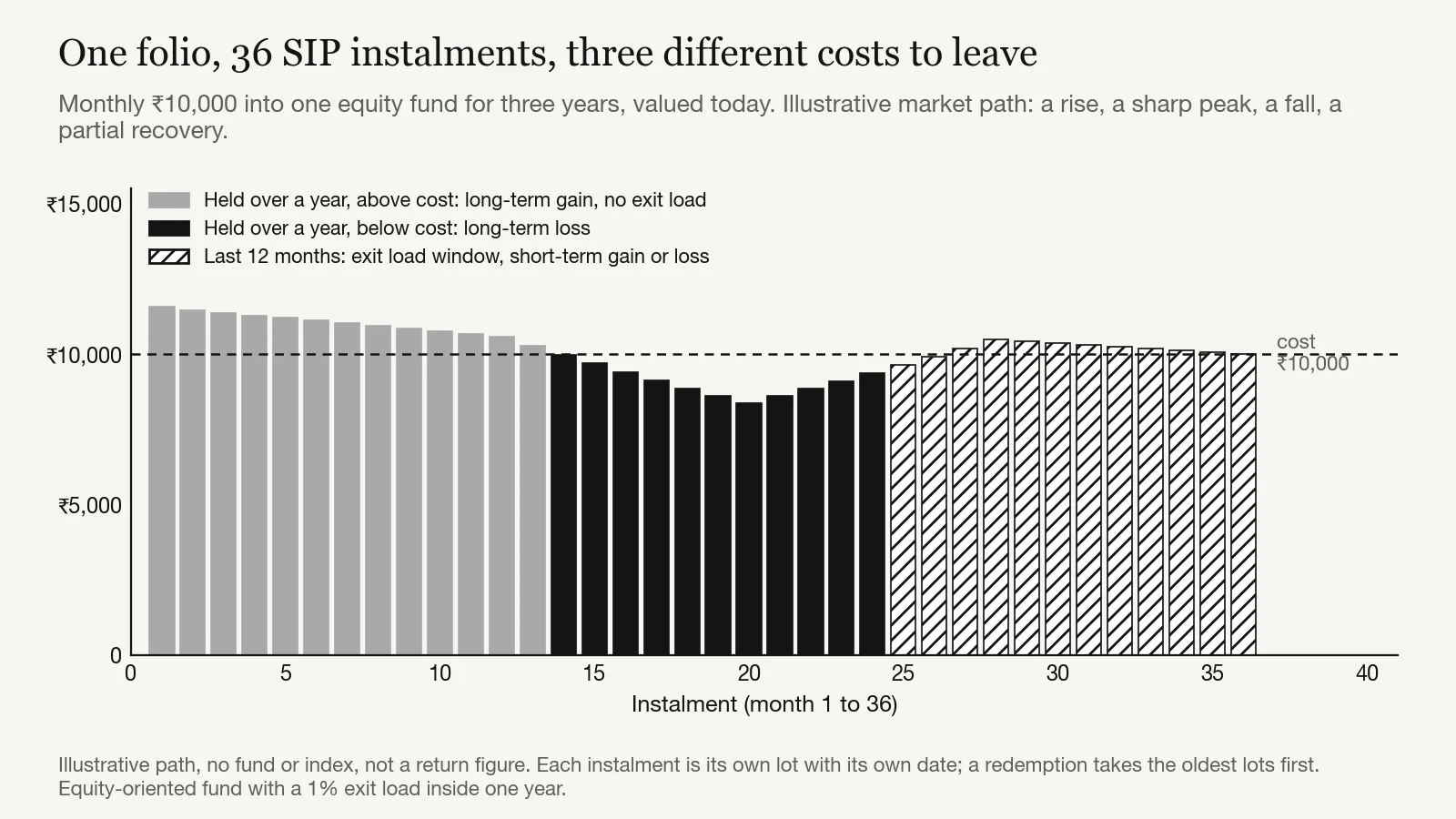
The chart is one folio. In a 17-scheme portfolio there are hundreds of these bars, and each one falls into a different bucket depending on when it was bought and what the market did afterwards. That is why "sell the funds I don't want" has no single price.
Capital gains on mutual funds in FY 2026-27
Rates before surcharge and the 4% cess. The ₹1.25 lakh exemption applies only to the equity-oriented row, and it is one pool shared with gains on listed shares and REIT and InvIT units. Which row a hybrid or multi-asset fund falls in depends on its average allocation over the year, which the fund house states in its tax note.
Units of equity-oriented funds bought before 1 February 2018 still get the old grandfathering: the cost is taken as the higher of what you paid and the 31 January 2018 NAV, where that NAV is capped at the sale value. The registrar's capital gains statement shows that value lot by lot.
The order of operations
What follows is the sequence that keeps each cost visible before it is paid. It describes arithmetic. Whether any particular fund should go is a recommendation, and that comes from a SEBI registered investment adviser, not from this page.
1. New money stops first
Cancelling a SIP in a scheme you intend to leave triggers no tax and no exit load, and the units already bought stay invested. Since December 2024 fund houses process a cancellation within two business days of a complete request (an instalment falling inside those two days may still be debited). There is also a SIP pause of a few months at many fund houses, which is an AMC facility with its own terms rather than a SEBI right. This also means you stop creating new lots inside the exit load window of the very schemes you are about to redeem.
2. Every lot on paper
The detailed Consolidated Account Statement has every transaction with its date, units and NAV (the guide on reading your CAS walks through it). From it you can build a lot list per scheme: purchase date, units, cost, today's value. The registrars' capital gains statements cover realised gains only (units already redeemed), so for planning you are working from the CAS. MF Central gives the same CAS and a consolidated capital gains statement across both registrars.
3. Sorting the lots
Four piles: lots that are locked (ELSS less than three years old), lots inside an exit load window, lots with a loss, and lots with a gain. Split the gains into short-term and long-term using the table above. On a 17-scheme portfolio this is a spreadsheet afternoon. Large old holdings often carry less tax than they look, because most of their lots are long-term; the awkward ones tend to be the recent SIP lots.
4. Losses and gains in the same year
The Act sets losses off in a fixed way. Short-term capital losses can be set against any capital gain, short or long. Long-term losses go only against long-term gains. Unused losses carry forward for eight tax years, but only if the return for the year of the loss was filed by its due date (31 July for most salaried people filing ITR-2).
One consequence is easy to miss. The set-off happens before the ₹1.25 lakh exemption, so a long-term loss booked in the same year as long-term gains that were inside ₹1.25 lakh anyway reduces gains that would not have been taxed. So the timing of the loss lots matters as much as the loss.
India has no wash-sale rule for mutual funds. If you sell a lot at a loss and put the money into another scheme, the loss still counts; the new units simply start a new holding period and a new exit load clock.
5. The exemption, in two financial years if the dates allow
Long-term gains on equity-oriented funds are taxed at 12.5% only above ₹1.25 lakh per person per financial year. Straddle 31 March and you get two.

The gain belongs to the year whose NAV date applies to the redemption. Any request submitted after the cut-off time (3 pm for most schemes) on the last business day of March gets the next business day's NAV, which falls in April. People who want a lot in March submit it well before that.
6. Load windows that close soon
Where the load is 1%, a lot that leaves its load window in three weeks costs 1% of its value less if it leaves in four. And an equity-oriented lot that crosses twelve months of holding moves from 20% tax on the gain to 12.5% above the exemption. Waiting has its own cost, which is that the money stays in a scheme you had decided to leave, exposed to whatever that scheme does in the meantime. The lot list shows both numbers side by side. Neither is a forecast.
7. What is left is the real price
After the steps above, what remains is mostly short-term gains on recent lots, and long-term gains above the exemption. That figure is the cost of finishing the job this year. The other side of the comparison is what the duplicate schemes cost to keep: each one charges its own expense ratio on the money in it, every year, and the overlap check shows how much of that money is holding the same stocks anyway.
If the funds were inherited
The units cannot be redeemed by the family until they are transmitted. SEBI's master circular bars fund houses from accepting a redemption from a claimant while transmission is pending, so the first job is paperwork, and the rules for it changed this year.
SEBI's circular of 23 July 2026, in force from late August, standardised transmission for mutual fund units. A surviving joint holder needs only the death certificate. Every other claimant gives a transmission request form, the death certificate, a copy of the account statement and the client master list of their own demat account, plus the items below. For units held in statement-of-account form the thresholds are per fund house:
Probate is no longer mandatory. The fund house has to complete the transmission within 21 calendar days of receiving complete documents. For units held in demat the thresholds are ₹30,000 and ₹30 lakh, per demat holder. A succession certificate or court order removes the need for the indemnity and the heirs' NOC. MF Central lets a claimant start a transmission request online, but the original form and documents still have to reach a CAMS or KFintech branch within 15 days or the request lapses.
On tax, inheritance is not a transfer. The heir takes the parent's cost and the parent's holding period, so most lots in an old portfolio are long-term from the day they arrive. Tax arises only when the heir redeems. Where the units are split among several heirs, each heir has their own ₹1.25 lakh exemption each year. ELSS units come with a softer lock-in: the heir can withdraw once a year has passed from the original allotment, instead of three.
Transmission itself is not a redemption and does not attract an exit load. Whether a later redemption by the heir measures the load window from the parent's allotment date or from the transmission date is a question for the fund house or registrar; some Statements of Additional Information address it under transfer and transmission. For an old portfolio the question rarely matters, because most lots are past any window.
Old folios that will not redeem
Two administrative problems often hold up a consolidation.
The first is KYC. Since 2024 a KYC record is "Validated" only when PAN, name and address match official databases and PAN-Aadhaar linkage is verified. Records that are only "Registered", often because PAN and Aadhaar are not linked, can still be used with the fund houses where you already invest; linking them (a late fee applies) and updating the KRA moves the record to "Validated". "On Hold" now mostly means neither mobile nor email has been validated, which is fixed by validating them on a KRA site. SEBI's KYC FAQ says investors who were clients before April 2024 are allowed to exit existing investments after due diligence even if some attributes cannot be verified.
The second is the bank account. Redemption money goes only to a registered bank account. If a redemption request comes with, or within 10 days after, a change of bank mandate, it is paid only after a cooling-off period of 10 days from the bank change. A change of bank details written into the redemption form itself is not acted on: the redemption is processed and paid to the account already on record. A typical case: a closed salary account on a 2016 folio. If the current account was registered more than 10 days before the redemption, on a standalone form or through the multiple bank account registration facility, there is no hold.
Frequently asked questions
Can I consolidate mutual funds without paying capital gains tax?
Not by your own action. Money moved from one scheme to another is a redemption, taxed as a transfer. Only a merger of schemes or plans carried out by the fund house is tax-neutral. You can reduce the tax and the load by sequencing: losses first, long-term gains within the ₹1.25 lakh exemption in each financial year, and lots outside the exit load window.
Is switching between two funds of the same fund house taxable?
Yes. A switch is a redemption from the first scheme and a purchase in the second. Capital gains tax applies to the redeemed lots, and the first scheme's exit load applies to any lot still inside its window.
Is there an exit load when switching from a regular plan to a direct plan?
No. SEBI's master circular of 20 March 2026 bars an exit load on switches between the regular and direct plans of the same scheme. The switch is still a transfer for tax, so gains on the switched lots are taxed.
How does the ₹1.25 lakh long-term capital gains exemption work when redeeming several funds?
It applies to the total long-term gains on equity-oriented funds, listed shares and REIT and InvIT units for one person in one financial year. Redemptions dated 31 March and 1 April fall in different financial years and get separate exemptions.
How do I transfer a deceased parent's mutual funds to my name?
Through transmission at the fund house or registrar. Under SEBI's July 2026 framework a nominee needs a request form, the death certificate, the account statement and the client master list of their own demat account; without a nominee, the documents depend on the value held with each fund house (₹10,000, ₹10 lakh and above). Redemption is possible only after transmission is complete.
Related guides
- Harvesting long-term gains before 31 March, lot by lot
- Mutual fund overlap across your whole portfolio
- Your fund has lagged for three years: the questions to answer before you exit or wait
- Reading your CAMS or KFintech CAS line by line
- Regular vs direct plans: what commission has cost you, in rupees
- Idle cash and the emergency fund: where to keep it, after tax
Sources: SEBI Annual Report 2025-26, chapter 5 (folios and unique investors at 31 March 2026); SEBI (Mutual Funds) (Second Amendment) Regulations, 2025, 31 October 2025 (exit load cap cut to 3%); SEBI (Mutual Funds) Regulations, 2026, as amended to 10 October 2026, regulation 2(1)(q) (exit load is levied on redemption or repurchase), regulation 44(3)-(4) on exit load and regulation 22(9) on exit without load before a change in fundamental attributes; SEBI Master Circular for Mutual Funds, 20 March 2026, paras 3.2.1 and 3.2.3 (mergers as a change in fundamental attributes), 5.6.5 (liquid fund exit load), 9.4.3 (cut-off times), the SID format and investor service standards (30-day exit window), 11.7.3-11.7.6 (exit load exemptions, prospective application, credit to the scheme), 15.15.6 (no redemption pending transmission) and 15.17.1 (bank account on redemption requests); scheme documents and addenda of HDFC, HSBC, ICICI Prudential and Mirae Asset mutual funds, January to August 2026, on exit loads, SIP load structures and ELSS; Indian Stamp Act, 1899, as amended by the Finance Act, 2019 (0.005% on mutual fund units from 1 July 2020); HDFC Mutual Fund note on capital gains statements (realised gains only), July 2026; HSBC Mutual Fund SIP pause and cancellation form; Income-tax Act, 2025, sections 2 (definition of transfer), 2(101), 3, 67, 70, 73, 76, 90, 108, 109, 111, 121, 196, 197, 198 and 263, in force from 1 April 2026; ICICI Prudential and HSBC Mutual Fund tax reckoners for FY 2026-27; Equity Linked Savings Scheme, 2005; SEBI circular of 23 July 2026 on simplification and standardisation of the framework for transmission of securities; SEBI circular of 14 May 2024 on validation of KYC records, SEBI FAQ on KYC norms (May 2024) and KRA status changes effective 1 June 2024; AMFI list of exceptional situations for redemption payment (change of bank mandate cooling-off) and AMFI best practice circular 26/2011-12 on change of bank details; MF Central service and consent text, read 29 October 2026. Corpus has applied to SEBI for registration as an investment adviser. This page explains how the rules and statements work and does not recommend any scheme. Investment in securities market are subject to market risks. Read all the related documents carefully before investing.
This is the lead-generation form
Get info from your blog visitors for lead funnel
Corpus
Guides on reviewing a mutual fund portfolio in India: reading your CAS, overlap, commission, what advice costs and who may legally give it. Written by the Corpus team.
Visit Site